
As a young boy, I tried and failed several times to fly a kite. While not rocket science, it was something I just couldn’t figure out how to do. More often than not, I’d take off in a sprint with the kite lagging behind and bouncing on the ground.
One day, my intuition told me that it was perfect kite-flying weather, so I grabbed my superhero kite (I don’t remember which one), and I headed out to the field next to my house, with my older sister in tow.
To my surprise, the kite was immediately grabbed by the wind and soared high into the air. I was delighted for all of three seconds. I was not prepared for the strength of the wind, and the kite was ripped right from my hands.
My sister, who at that moment was dancing around the field a little farther away, was unaware of my plight. I watched the kite fly higher and higher into the sky — and then it started coming down right toward her. I yelled at her, “Grab it! Grab it!”
She looked at me with arms outstretched, as if asking, “Grab what?” And that’s when the kite handle bonked her right on top of the head. She hit the ground as if the sky was falling and, needless to say, did not grab it. My kite caught another gust of wind and flew up and out of my life forever.
I have not successfully flown a kite since then. Have I tried? Well, I plead the Fifth. But, if I were to try again, I would heed the advice of the experts at SafeElectricity.org.
Kites and other toys like model airplanes or drones are perfectly safe. It is just best they be flown far away from overhead powerlines. Instead, choose large, open areas like a park or a field — and there are many from which to choose in Illinois.
If toys get stuck in a power line or even a substation, never try to retrieve them. Leave that to the professionals. The electric co-op or utility should be contacted for assistance.
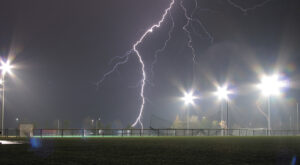
Additionally, check the weather ahead of time. Never fly kites or other toys when a thunderstorm may be approaching. Lightning can strike up to 10 miles away from a storm, even when it’s not raining.
The rule of thumb when it comes to weather safety is, if you hear thunder or see lightning, go indoors. This must be a fully enclosed building — not a porch or an open shed. And certainly do not take cover under a tree. If no building is available, find a hard-topped vehicle with the windows up. Then, wait at least 30 minutes after the last sound of thunder before going back outside.
For more information about electrical safety, talk to your local electric cooperative or go to SafeElectricity.org.