
A lifetime of culinary study began with a simple toy given to Chef Andrew Deuel as a child. Ultimately, that childhood plaything would become the namesake of a unique eating establishment in Jacksonville.
“My mom brought this little antique electric stove from Europe, and it was my rainy-day toy,” says Deuel. “It would heat up, [and though] it could barely fry an egg, I was just amazed by it.”
That sense of wonder never waned. In grade school, he was the only student who checked out the library’s Sesame Street cookbook. “I [remember] taking it out 13 times in a row,” he laughs, adding that his mother’s spice rack was another of his early inspirations. “As a little kid, I was like, wow, you can take this and mix it with that to come together. It was almost like looking at a chemistry set.”
Years later, when sharing the story of what led him to become a chef, someone mentioned offhandedly that “the little stove” would be a great name [for a restaurant] someday. Eventually, that would come to fruition. But before that, Deuel’s love of all things culinary would take him abroad.
Originally from the Midwest, he received his Associate of Occupational Studies in culinary arts in Vermont, afterward opting to stay with his aunt and uncle for an internship in Boston. “They said to me, ‘Andrew, once you finish your schooling, you’re going to have to get some experience abroad, and if you [do], we would love to back you on your first restaurant,’” says Deuel. “Luckily, I didn’t need their help, but just saying that lit a fire underneath me.”
Their suggestion eventually led him to the Italian Culinary Institute for Foreigners. “It was inside a castle … on the top of a hill in Costigliole d’Asti,” he describes. “It’s in the northwestern region of Italy, and it was an amazing school.”
His time there included excursions to different manufacturers introducing their products to the new chefs. “The idea was we get back home and we remember visiting Lavazza Coffee Company, which I did, and then we’ll sell it in our restaurant, which we do right now,” Deuel explains. “We did a prosciutto factory tour. We did an olive oil company tour … wine tours … all these big Italian companies. … All these beautiful Italian products, we were watching how they choose their ingredients and how they make their products.”
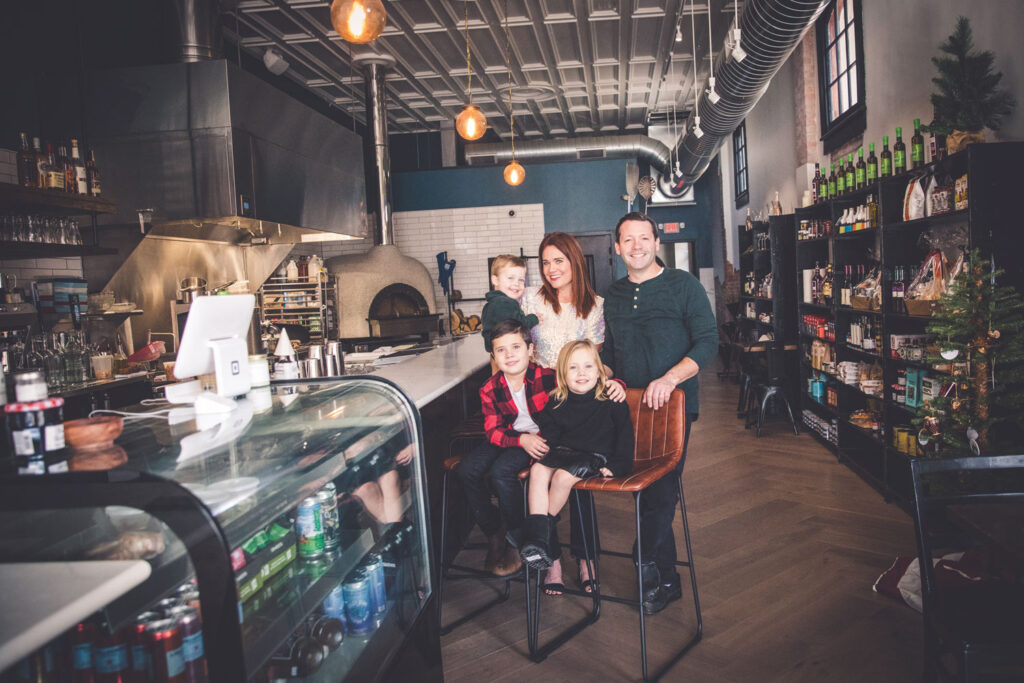
A few decades later, after years of working as an executive chef at Michelin-rated restaurants in New York and Chicago, he and his wife Liz are now back in the Midwest raising their young children. Five years ago, they opened an eatery, wine bar and market in Jacksonville, where some of those Italian products are being sold and used as ingredients.
Its name? The Little Stove.
“At first, we weren’t going to be a restaurant. We were just going to be a bar with cocktails and drinks and the market,” says Deuel. “I had to dig down deep, and I was like, ‘Liz, I don’t think I’m ready to stop cooking yet.’”
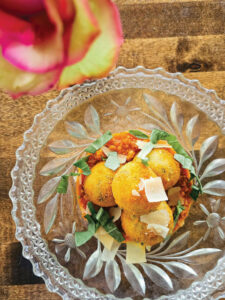
The menu changes, sometimes daily. “I’m always working on new dishes,” he says. Examples range from focaccia with whipped ricotta and truffle fries to swordfish and arancini. Perhaps of greatest note, however, is the variety of certified authentic Neapolitan-style pizzas. Fewer than 100 pizzerias in the U.S. hold that distinction.
“[The dough is] a high percentage of water to flour, so it’s wet and sticky, but when it bakes up super-fast in a super-hot hearth oven, it’s more digestible, so you feel lighter,” explains Deuel. “The dough is soft in Naples, [and] they don’t slice their pizza in triangles. It’s served whole, with a fork and knife.”
While the pizza is served exactly as it is in Naples, at The Little Stove patrons are given scissors to make things a little easier. “The crust is crispy. It’s soft in the center and on the bottom. … When you’re eating it, you don’t get filled up the way you would with American pizza,” he adds.
All tools and ingredients used to make the pizzas are from Italy. That passion for authenticity applies even to the mozzarella cheese he makes from curds and stretches into fior di latte — “the flower of milk.” “I don’t buy the fior di latte and cut it up. I stretch [it]. I make the cheese that goes on our pizza,” he explains.
“We have customers who have traveled to Italy, and they’ll recognize our sign out front. … If you’re a certified Neapolitan-style pizzeria in Naples, Italy, you have the exact same sign outside your restaurant,” he says. “It’s a trademark [with] the mascot of Naples, Pulcinella … behind Pulcinella is Mount Vesuvius, which is known for giving the San Marzano tomatoes their sweetness. [Those are] the imported tomatoes I use on our pizzas — and I must use these tomatoes, otherwise I will lose my certification. Same thing with the flour.”
Another distinction is the restaurant’s wood-burning hearth oven, which prior to The Little Stove, he had never used. “If it’s our shrimp appetizer, it’s going in there. If it’s mac and cheese, it’s going in the hearth. If it’s asparagus, it’s going in the hearth. … Everything’s cooked out of the hearth,” Deuel says.
“A lot of people think my wood-burning hearth oven is the little stove. No way, that’s my gigantic wood-burning hearth,” he laughs. “The little stove … it’s on a mantel in the front of the restaurant.”
PHOTOS COURTESY OF THE LITTLE STOVE
 The Little Stove