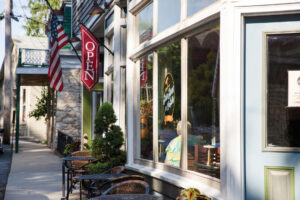

Few businesses that started as a trading post in the 1800s remain successful today. Fewer still are in the same building with the original fixtures and furniture. But that is not the case at Wittmond’s in Brussels, where time seems to have frozen in place.
The business began when Conrad and Mary Wittmond immigrated to Calhoun County from Germany in 1840, opening the mercantile in 1847. “They were here before the church,” says current owner and Illinois Electric Cooperative member Charles Burch, whose mother was a Wittmond.
A home was added to the building in 1863, and in the late 1800s, a new generation of the Wittmond family added a hotel above the storage rooms once stocked with supplies for the general store. The following generation converted the storage rooms into a restaurant for hotel guests.

It is all still there in the same long, 10,000-square-foot building. Some of the original dusty merchandise remains on the shelves of the store, which adjoins the restaurant. “If you look hard enough, it all might disintegrate in front of your eyes,” Charles says.
“The restaurant menu has remained unchanged for over 75 years. People just come in, sit down and eat,” he adds. “There is no printed menu.”
Bountiful servings come family-style and begin with separate plates of corn relish, beets, applesauce, apple cider vinegar coleslaw, peach marmalade, rolls and pork sausage, all homemade.
The main course includes fried chicken, mashed potatoes and gravy, corn and green beans. “I cannot imagine how many chickens we have served,” Charles remarks. “There used to be a large chicken coop behind the building.”

For dessert, Wittmond’s serves peach, apple, pecan or blackberry cobbler topped with vanilla ice cream.
Dining room walls are decorated with large, elaborate gold-framed photos of the five generations of the Wittmond family. Each contributed to making the business a landmark. The building is now on the National Register of Historic Places.
“I started working in the restaurant when I was 9,” Charles says, adding that he was born in 1947. “I have done everything there is to do in this building, and then some.”
He details the history of each room, pointing out where there was once a post office from 1920 to 1970, where the family living and dining rooms were, the location of the “birthing room” where 14 family members were born, and the room used for funerals. “Fifty family members are buried in the cemetery next to the building,” he says.
A framed newspaper article on the wall recounts how the building once served as a safe stop on the Underground Railroad, sheltering enslaved people seeking freedom until the Civil War ended in 1865.

Although the hotel is now closed, the 10 guest rooms appear ready for guests, complete with original furniture and bed linens. “A lot of people ask to stay here,” Charles says.
The longevity of Wittmond’s is particularly remarkable considering its isolated location on the southern tip of a peninsula of Calhoun County. Wedged between the Illinois and Mississippi rivers, it has never been easily accessible.
“In 1847, the only way to get here was by stagecoach or a wagon ride over a dirt road from a steamboat docked a mile away on the Illinois River,” Charles says.
Today, guests must take the Brussels Ferry. From State Highway 100, the 5-minute passage across the Illinois River connects to a narrow two-lane road and a 7-mile drive to Wittmond’s.
“If you live here, you have to take the ferry to get to any kind of store, gasoline station or hospital,” Charles acknowledges. “Even in the modern world, we remain remote.”
Yet, the limited accessibility has never kept customers away, and the restaurant is filled when it is open Friday through Sunday.

Charles estimates 80% of the customers are tourists from Missouri and Illinois. Church groups, car and motorcycle clubs and senior living homes make the restaurant a popular destination, and most make the journey to Wittmond’s an annual event.
The guest book is also signed with the names of people who arrive from every state and from across the globe. “I am dumbfounded how they find us, since we do no advertising whatsoever,” he says, pointing to recent signatures from Croatia and South America.
Asked what is new in the 1847 building, a vacant look comes over Charles’ face. “I cannot think of anything,” he says, laughing, “but after 178 years, the mortgage has been paid off.”
 166 E. Main St., Brussels