 When someone lives to be 100, it’s a time for celebration. The same is true for Historic Route 66, which this year celebrates a century of guiding travelers 300 miles starting in downtown Chicago and continuing through Illinois to St. Louis, and then traveling another 2,148 miles on to Los Angeles.
Over the decades the old road has been in use, it has had many historical milestones. When first dedicated on Nov. 26, 1926, Route 66 was 2,448 miles of paved and unpaved state roads, stitched together and renamed. Signs with the black-and-white U.S. 66 shield led motorists through the center of more than 200 towns, immediately earning the roadbed the title “The Main Street of America.”
Slowly, the route was paved, with Illinois being the first state to complete the task in 1929. It would not be until 1938 that the entire length was surfaced.
In his 1939 novel “The Grapes of Wrath,” John Steinbeck immortalized Route 66 with its second nickname — the “Mother Road” — describing it as the “road of flight” for people seeking work in California as they fled crop failures in the Midwest and the harsh reality of lost jobs during the Great Depression.
Then, during World War II, the route became a military necessity, serving as a vital strategic corridor for military convoys transporting troops and equipment.
In 1946, the song “Get Your Kicks on Route 66” was recorded by Nat King Cole, and later by 200 other artists. The popular lyrical travelogue kickstarted the most popular era of Route 66 and paved the way for tourism culture.
The beginning of the decline for the road came in 1956 with the signing of the Interstate Highway Act by President Dwight D. Eisenhower. As sections of Route 66 were replaced with interstates offering a faster travel alternative, the Mother Road fell out of favor.
On June 27, 1985, after almost 60 years of having been paved, repaved, rerouted and widened, Route 66 was officially removed from the U.S. Highway System. Decommissioned, the first long-distance highway theoretically no longer existed.
 But, it had become known throughout the world, and the public remembered. Small businesses that served Route 66 travelers in Illinois and elsewhere and had survived to the end began to welcome a new type of traveler seeking attractions and experiences that had been the fabric of the history of the road.
The motels and restaurants were still there, awaiting a new generation who wanted to see, eat and sleep in authentic symbols of the past.
With an objective of raising awareness of the importance of the route in American history, Route 66 associations were organized in Illinois and each of the other seven states it passes through.
In 1999, the National Park Service Route 66 Corridor Preservation Program began to provide grants for buildings, road segments and cultural landscapes along the length of the corridor. “Historic Route 66” signs started to appear along Illinois interstates, guiding travelers to sections of the old route.
The result is that today U.S. Route 66 is no longer just a means to get to the West. At 100, new life has been added to the old pavement, and the road is once again an attraction.
As much as 80% of the old highway is still in use, and some of the small establishments that served travelers are surprisingly still in business. Other businesses have opened that cater to the memory of the old highway, and in isolated places the scenery is not much different than when the road was commissioned 100 years ago.
All rekindle memories of the legendary road, and what a ride along its past was like. In effect, it has become a linear museum with independent curators.
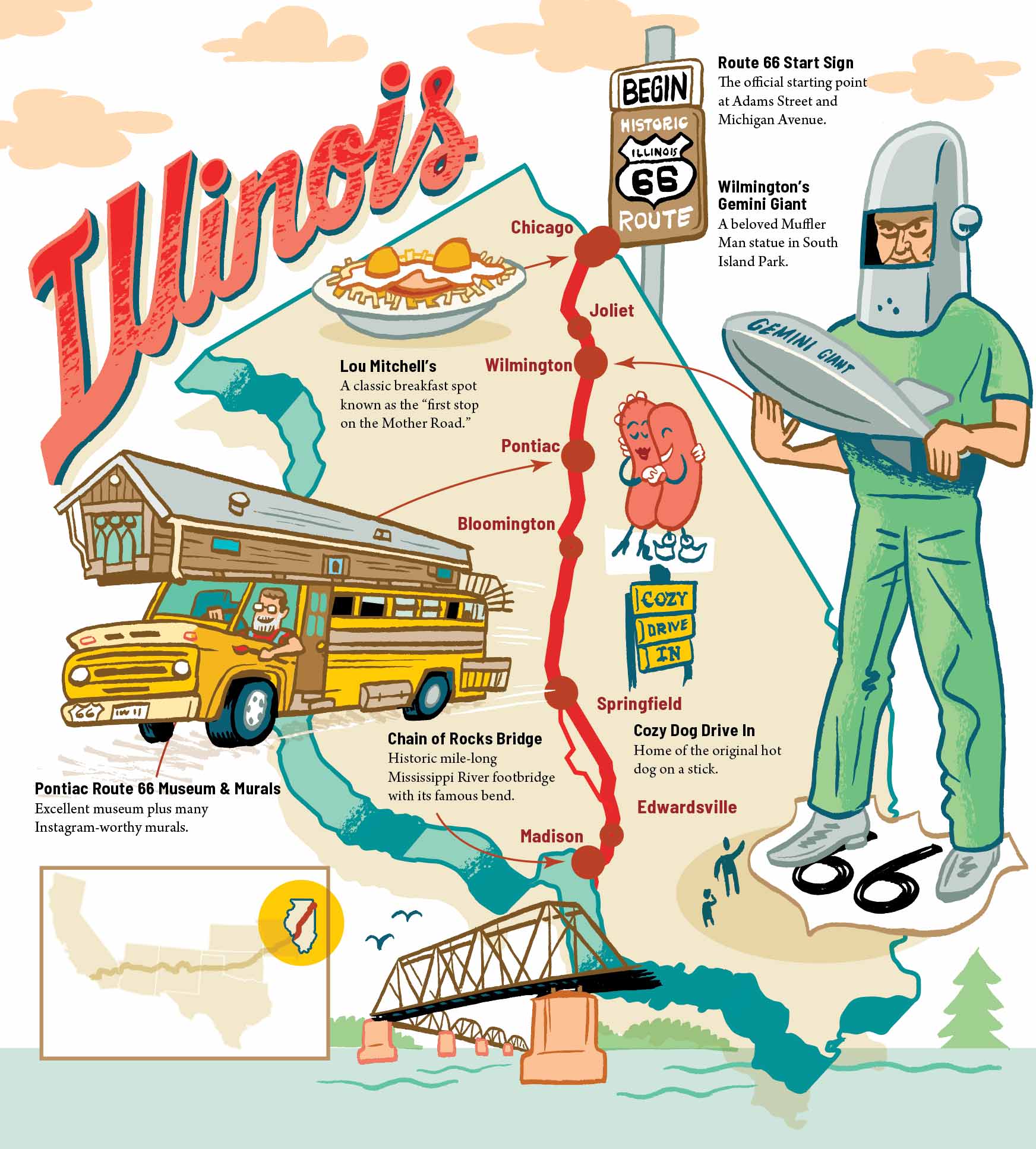
Route 66 in Illinois today
While there are too many Route 66 attractions in Illinois to cover them all, here’s a glimpse of what awaits discovery in the state.
The official Route 66 starting point (or end if traveling west to east) has long been at 122 S. Michigan Ave. in Chicago. There, a pylon with information about the start of the historic route and the first historic Route 66 sign appeared with the word underneath reading “BEGIN.” However, on March 25, 2026, the city recognized Navy Pier as the starting point of the iconic roadway.
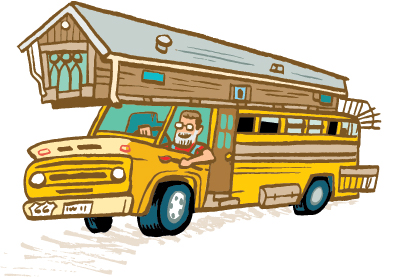
After leaving Chicago, The Route 66 Hall of Fame and Museum in Pontiac is home to thousands of items relating to the road. Operated by the Route 66 Association of Illinois, exhibits are devoted to the people and places in Illinois that contributed to the history of the road.
One exhibit is a school bus converted by Bob Waldmire into a mobile home. A Route 66 legend, Waldmire lived in the bus (and earlier in a VW van) from the late 1980s until his death in 2009, all the while creating meticulous drawings of sights he encountered along 66.
One attraction that originated before Route 66 has become an interesting stop since the road opened in 1928 — Funks Grove Pure Maple Sirup in Shirley. Although in business since 1891, the family-owned enterprise eventually grew to depend on the steady stream of customers that Route 66 brought to its door.
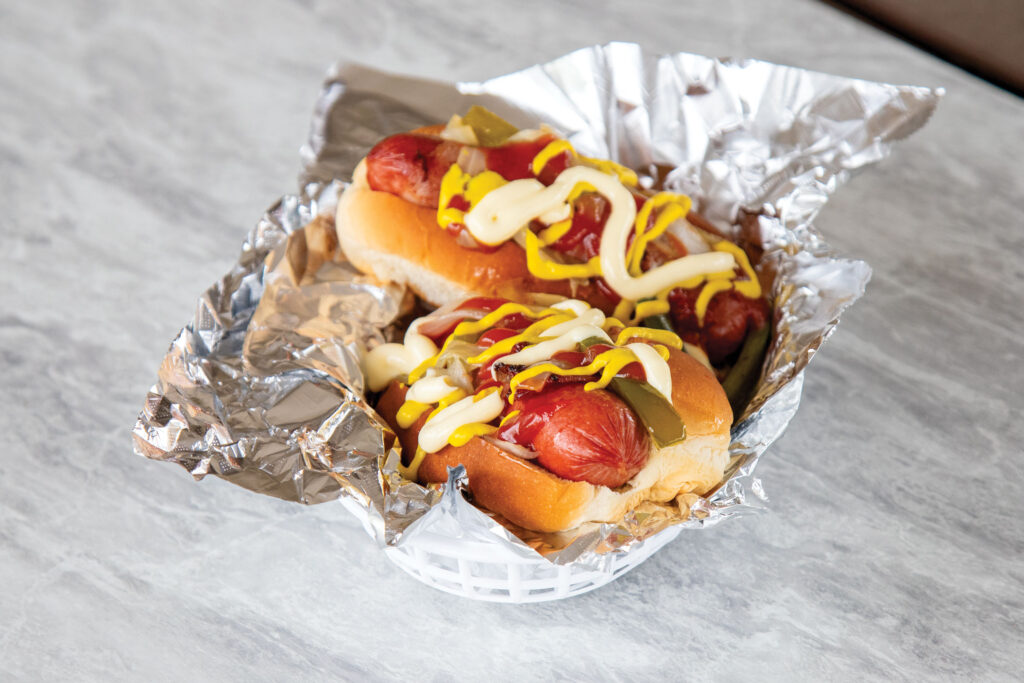
 Another favorite stop for road trippers is the Cozy Dog Drive In in Springfield. Since the mid-1940s, the eatery has been serving hot dogs dipped in a cornbread-type batter and served on sticks. Laminated tabletops feature an annotated cartoon map of the road, and shelves of books contain Route 66 reading material for diners to borrow.
The Ariston Cafe in Litchfield holds the distinction of being one of the longest-operating restaurants along the legendary road. It is listed on the National Register of Historic Places.
Few classic roadside motels from the Route 66 era remain in Illinois, but for those seeking the experience of a bygone era of travel, the 1950s Carlin Villa Motel in Carlinville revives the nostalgic charm of the Golden Age of Route 66 with vintage furniture.
In Mount Olive, the canopy-style Soulsby Gas Station appears much like when gasoline was first pumped there in 1926. In 1931, a new alignment of Route 66 brought it within a few feet of Soulsby’s pumps, and fuel continued to be sold there until 1991. Preservation of the pristine station is a labor of love for local volunteers of the Soulsby Preservation Society.
Quirky 66 attractions
Some towns capitalize on their roadside location with attractions that have no actual relationship with the Mother Road. In Lincoln, a 40-foot-long wagon, officially named “Railsplitter,” was built by David Bentley to commemorate the 75th birthday of Route 66 in 2001. Measuring 25 feet tall and 40 feet long, the landmark is recognized by the Guinness Book of World Records as the World’s Largest Covered Wagon.
Near Auburn, the last hand-laid brick surface of the road remains. Finished in 1931, the 1.4-mile preserved segment can still be traversed by automobile.
The Pink Elephant Antique Mall in Livingston features a myriad of attractions that capture the character long associated with the Mother Road, that of using innovation and quirky approaches to entice travelers to stop. While the antique mall is where people shop, in front of the store it is the life-size pink elephant, an original 1960s Futuro House shaped like a UFO, and an ice cream shop shaped like an ice cream cone that are the backdrops for photos.
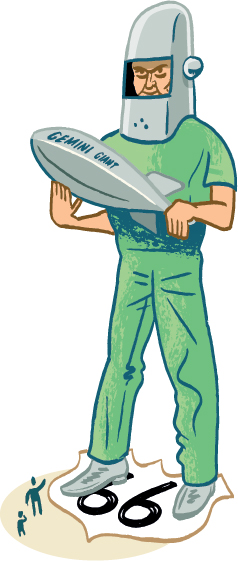
Wilmington proudly displays The Gemini Giant, a 30-foot tall, helmeted astronaut dressed in a green jumpsuit holding a silver rocket that was the mascot of several businesses in town along 66 beginning in 1960. Today it has been preserved and can be seen in Wilmington’s South Island Park.
The Brooks Catsup Bottle water tower on the south side of Collinsville is claimed to be the largest catsup bottle in the world at 70 feet tall, perched atop a 100-foot stand and having a 100,000-gallon capacity (theoretically 640,000 bottles of catsup). Although not erected as a Route 66 attraction, it is an example of mid-20th-century novelty architecture and is a popular stop for those en route to California.
A surprise ending
For decades, the end of Route 66 in Illinois held one last surprise for unsuspecting travelers motoring their way into Missouri. Driving over the Chain of Rocks Bridge connecting the two states, they would encounter an unusual 30-degree turn in the middle of the bridge high over the Mississippi River.
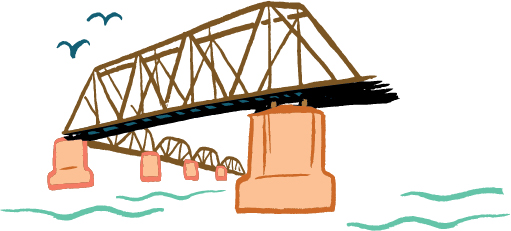
Today, the mile-long, 24-foot-wide span welcomes bicycles and pedestrians instead of cars and contains placards about the history of the bridge and Route 66.
For a list of events celebrating the 100th anniversary of Route 66 through the end of 2026, visit
illinoisroute66.org/il66centennial.
Places to go to learn more
- Route 66 Hall of Fame & Museum in Pontiac, housed in a restored historic firehouse and city hall, features extensive memorabilia from Illinois towns along the route.
- The Joliet Area Historical Museum doubles as the Official Route 66 Visitors Center for Illinois.
- The American Giants Museum in Atlanta features the large fiberglass men and women spotted along Route 66.
- The Illinois State Fair Route 66 Experience is located inside Gate 2 of the fairgrounds in Springfield and highlights Illinois businesses from Chicago to Chain of Rocks Bridge along the Mother Road.
- The Route History Museum in Springfield offers a unique, immersive experience focused on Black history along Route 66. Included are exhibits on the Negro Motorist Green Book, an annual travel guide published from 1936 to 1964 providing Black travelers with lodging, dining and other information necessary to stay safe and comfortable prior to the Civil Rights Act of 1964.
- Litchfield Museum & Route 66 Welcome Center focuses on both local history and the legacy of Route 66 through a variety of exhibits, including Historic Route 66 artifacts and signage, displays about local businesses and personalities tied to the Mother Road, and more.