Almost every weekend between March and November in Brownstown, up to 150 custom-built racecars speed bumper to bumper around a quarter-mile, dirt oval racetrack at speeds approaching 100 miles per hour.
“It is definitely entertainment,” says Josh Carroll, the owner of the Brownstown Bullring raceway, referring to the roar of the cars in each race, and the anticipation in the crowd for the inevitable spinouts and sparks flying from cars ramming into each other. Spectators watch from a grandstand and behind a high chain-link fence, separated only a few feet from the action on the steeply banked track.
“Keep a top on your drink,” Carroll says. “If there is dirt in your beer, they are racing.”
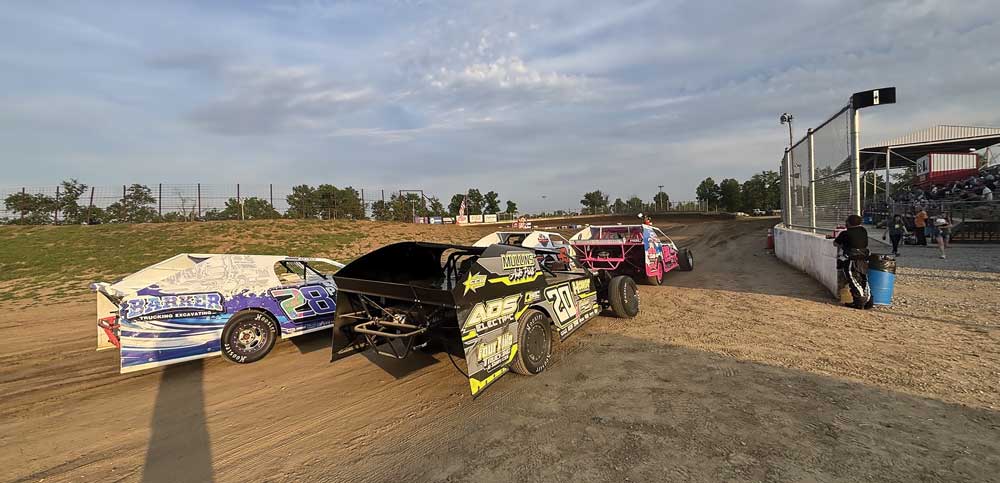
 At the center of the spectacle are the racecars themselves. The fabricated car bodies are polished until they glisten and are painted in every conceivable combination of vivid colors. Many colors are fluorescent paint that glow as the evening turns to night and the overhead light poles illuminate the track.
Advertisements for local businesses which sponsor a car are prominently displayed on the cars, with more than one of the sponsors ironically being a personal injury law firm.
Even the physical appearance of the racecars is entertaining to a first-time spectator. For less wind resistance and greater speed, car roofs are lowered and resemble the passenger compartment of an automobile that was about to be crushed for scrap before someone in charge of the car smasher changed their mind.
Standing in front of a car, one can’t help but notice a decided tilt in the body to the left, as if the car had been crashed into broadside, knocking it out of alignment and leaving it destined to only make left turns. However, the wayward lean allows the car to grip the track better in the turns and enter the two short straightaways at a higher speed.
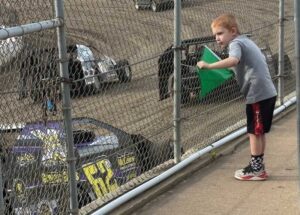
There are plenty of diehard race fans and backyard mechanics in the stands. But children of all ages are also everywhere, waving green and checkered flags, playing with their Hot Wheels on the bleacher seats, collecting handfuls of mud flung into the stands as the cars roar past, or just enjoying the spectacle alongside their parents clad in a sweatshirt or T-shirt emblazoned with the logo of their favorite driver.
For many of today’s drivers, the sport has been in their family for generations. Most have a father, grandfather or even a great-grandfather who raced. They were often racing go-karts as children or helping family members prepare a car for an upcoming race.
“I have been ‘wrenching on cars’ since I was 16,” says driver Doug Klein. “I would ride my bicycle home from school and get to work. Racing has been in our family for generations.”
The action starts when the cars leave the pit area, with their engines rumbling and backfiring as they make their way onto the track for practice laps. They line up to get into position for a rolling start just before a green flag is lowered from a tower overlooking the track, and the noise becomes so loud it would not be a surprise if the cars took off and started to fly.
 As the cars enter the two ends of the oval raceway, drivers apply the brakes, shifting the car’s weight toward the front wheels causing the car to turn sideways at a 90-degree angle to the track. Then, as the inside wheels lift off the ground, each driver uses the sliding motion to exit the turn into the 100-yard straightaway for several seconds before the next turn looms in the distance and the sideways maneuver is repeated.
Each night the cars compete in a variety of categories that include classes of racecars titled Modified, Stock Car, Hobby Stock, Late Model, Sprint, Sportsman, Pro-modified and B-modified. Each class has specific rules and regulations regarding the build of the body and the power of the engine, along with other equipment requirements and prohibitions.
Races begin with several laps of qualifying heats followed by eight- to 12-lap heats to determine position for the final series of races of 25 and 40 laps.
Carroll says attendance is usually about 2,000 fans, and that most drivers come from within 30 miles of the Illinois track. “It is a historic sport,” he says. “Dirt track racing started in the U.S. before World War I and became popular in the 1920s and 1930s. The Bullring dates to the 1950s, and for decades operated as Dirt Trackers Unlimited and then the Fayette County Speedway. Because of its tight quarters, fans affectionately referred to it as the ‘bullring’ long before the name became official in 2023 when I purchased the track.
“This is an expensive sport,” he continues. “The car frame and everything, but the engine is about $45,000, and the motor is another $50,000.”
And then there are the tires. Unlike a common pedestrian car tire, which may cost $150 and is typically good for a minimum of 30,000 miles, racecar tires last less than 100 laps around a dirt track and cost about $250 each.
Drivers actually add the grooves to each tire themselves using a heated electric grooving iron to cut away rubber to create, or deepen, tread patterns. This improves traction by giving the tire a sharper edge to bite the track, helps the tread flex to conform to the surface, and channels away mud or debris. Tire pressures range from 6 to 12 pounds per square inch depending on the position of the tire.
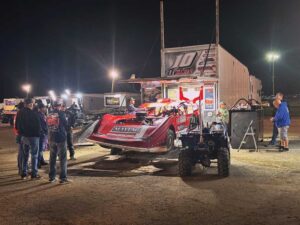
Some drivers arrive on race day with their car towed on an open trailer. Others spend up to $100,000 on the rig hauling the racecar to the track, according to driver Daryn Klein of Fairview Heights. “That includes the camper-like van that tows the trailer behind with the car and the equipment and spare parts inside the trailer. We can build an entire racecar, from what we bring along.”
The more sophisticated racecar trailers store cars above the main floor of the trailer and are known as “stacker trailers.” They use heavy-duty hydraulic or winch-driven lifts to elevate the vehicle to the ceiling.
For those who desire to see the racecars up close at the Bullring, a pit pass can be purchased for $40 which allows spectators unlimited access to pit row, where they can inspect the cars before or after the races and talk to the drivers and mechanics.
There is prize money for winning or placing in a race, but most drivers do it for the thrill of the sport and the camaraderie of being part of a team. Depending on the finishing position, drivers can earn from $100 to $1,200 on a weekend, and up to $20,000 for special races held periodically throughout the season.
Drivers who do not earn a living from racing but consider it just a weekend sport compete in up to 35 races a year. “Professional drivers who travel track to track every week may race in as many as 100 races across the nation,” Daryn says, “but after 35 races, I am ready for deer season.”
Brownstown’s racing history
Racing of some sort has been a part of Brownstown’s history for more than 100 years. The sport began with horseracing in the 1920s, followed by homemade cars racing on a straight track in the 1930s and 1940s. When the Bullring opened as the Fayette County Fairgrounds Speedway in the 1950s, races included motorcycles and four-wheelers, as well as stock cars.