
Considering that 2026 is the International Year of the Woman Farmer, the work of an organization known as Illinois Agri-Women (IAW) takes on heightened meaning. Two of its initiatives in particular — GoAg3 (Generations of Women in Agriculture Across America) and Women Changing the Face of Agriculture — serve to celebrate both past and present generations of female farmers and inspire young women to explore potential careers in agriculture.
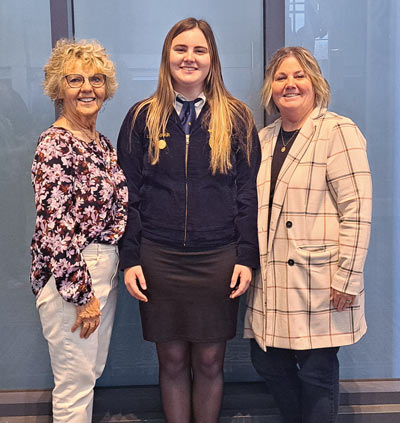
IAW, an affiliate of its national counterpart American Agri-Women since 1974, was organized to promote a better understanding of agriculture and the family farm system. Members Penny Lauritzen (since 1980), Jenny Larkin and Libby Larkin — mother, daughter and granddaughter, respectively — are each doing their part to spread the word.
Penny, a past president of IAW and a former farm manager, is the driving force behind GoAg3. “The Generations project started about five years ago as a way to entice the American Agri Women to Illinois for their annual convention,” the Lanark resident explains. Unfortunately, that didn’t work out, so IAW decided to carry the project out on its own.
“That was kind of the beginning,” Penny continues. “It was somewhat in honor of my mom. [Phyllis Johnson was] probably not a typical farm girl. She was not really involved in her parents’ farm operation, but when she and my dad got married, she ended up jumping in with both feet.”
One example: In the 1970s, Phyllis recognized the need for a catering business in Bureau County and addressed it using a farm-to-table (or farm-to-fork) approach — long before it became a culinary movement.
The Generations initiative spotlights contributions made by families with three or more living generations of women who have made and are making an impact in the industry — whether through production farming, agri-business, education or leadership.
Ironically, Penny, Jenny and Libby aren’t eligible, as there isn’t a full-time farmer among them, which is one of the stipulations. All are active in the industry, however. Penny pays it forward through the organization. Jenny works part-time on her husband’s family farm in Pontiac, where they grow corn and soybeans. Libby received the National FFA Organization (FFA) American Degree — the highest degree achievable in the FFA organization — and is now a student in the agriculture program at Western Illinois University.
Jenny, a graduate of Illinois State University, earned her ag business degree before meeting her husband Dale. Later, she returned for a master’s in human resources when her career in the nonprofit world demanded it. Eventually, the farm came calling.
“My husband and I [run the farm] now. My father-in-law passed away in February, but we officially took over two years ago,” she explains. “We’ve been farming for about 15 years. When the kids were little, I wasn’t on the farm much. … I showed up on the weekends and occasionally drove a tractor.”
It was while her father-in-law was in the hospital that the situation changed. “Dale said to me, ‘Do you remember when you told me you had all those vacation days?’ I said yes, and he said, ‘Well, I need you to run the combine.’ I said, ‘No, I’m not,’” she recalls. The couple went back and forth until finally Dale told her, “Yes, you can. I will teach you, and you will do just fine.”
These days, Jenny works both for the nonprofit and on the farm. “[Now] I ask all the time if I can be a full-time farmer, but he doesn’t let me,” she laughs.
Libby can’t recall a time she wasn’t out on the farm. “I started working on the family farm when I was, I don’t even know how old,” she says. “As long as I can remember, I’ve always been out there doing something, helping, whether it was [with] Grandma making sure everyone was fed … [or] sitting in the shop, or in the tractors with Dad or Grandpa.”
She adds that during the pandemic, she spent a lot of time doing her homework in the cab of a tractor. “I got a lot of questions from teachers when we were required to be on Zoom calls [about] why I was sitting in a tractor,” she laughs.
Currently, Libby is working in Macomb, interning as a crop scout at Nutrien Ag Solutions. “The last two summers I worked in Dwight as an intern for the Nutrien there,” she says. “[I’m] kind of following the family business [by] going into the ag business world, with a minor in agronomy. Growing up working with crops, I fell in love with it.”
Unlike her daughter and granddaughter, Penny faced some hurdles early on. “I am old enough that when I was in high school, girls were not allowed to join FFA. They didn’t allow it until the year after I graduated, so I was not an ag student until probably 15 years after I graduated,” she explains. “Then I had a chance to go back … [and] adapt my college to be ag-oriented, because Jenny’s dad and I were farming, so it seemed important for me to get as much education in that realm as I could.”
Penny ultimately became a farm manager, representing absentee owners and getting involved with ag real estate and managing properties. “[I did that] on 80 farms [for] 25 years,” she says.
During those years, the women of Illinois Agri-Women were her best friends and supporters — Penny calls them her tribe. Later, when Libby and her brother grew more involved with 4-H and FFA, she and her mother also joined IAW’s ranks.
“We’ve both been involved in Women Changing the Face of Agriculture, the career development event that’s held every year,” says Jenny. “We’ve both volunteered at that event. Libby’s attended several years, [and] this last year she was one of the scholarship winners.”
“The Women Changing the Face of Ag project — the career discovery project that Jenny and Libby are more focused on — they reach out to both FFA and 4-H groups,” Penny explains, adding that thousands of Illinois students have benefited from it since the first program in 2010.
“[It] has had a tremendous impact on the young girls who have left high school and college and ended up in the ag career track, because of the mentoring that those women [and] the professionals who get involved with the program [offer], and also with one another,” she adds. “Those girls have found out how important that female network and support of one another is once you get out in an ag career.”
Having witnessed that herself, Jenny took advantage of an opportunity that came up to meet with the president of Heartland Community College, which has a satellite campus near her in Pontiac. “They did not have an ag program up until a couple years ago,” she says. “[I] became good friends with him, and [along] with him and the executive director, ended up being instrumental in helping raise money to build the ag program and the ag facilities there at the Normal campus.”
That program is now in its second year. “They’re doing very well,” Jenny adds. “When I went to school, the closest school was Joliet Junior College, [because] there wasn’t an ag school in this area, so it was nice to be able to bring that to this area.”
She also says that while the Women Changing the Face of Ag event has historically been hosted at a university, lately they’ve opted instead to utilize community colleges, because of the visibility it gives to those smaller facilities, where college may be more affordable.
As Jenny’s involvement with that project continues, Libby ponders her own future in agriculture.
“I plan on helping somewhere with farming, whether it’s on our family farm or somewhere else, I’m not really sure yet,” she says. “I stayed in Macomb this summer to work for Nutrien, just to get a different perspective from the eastern side of Illinois to the western side, and there is a difference, a major difference. I am currently working on getting my drone license to be able to fly and spray with drones.”
Meanwhile, Penny’s work with the Generations project is about to celebrate its first major milestone.
“On Aug. 21, we will be announcing the three of what we’re calling our legacy families. There will be three families introduced that day who have at least three generations, if not four or five, who have been involved in ag, and one generation is still full-time farming,” she says. The event will take place at the new Agriculture Complex Jenny helped spearhead at Heartland Community College.
While the influence of agriculture on the female generations of her own family could be considered a microcosm of IAW’s Generations project, Penny is just as excited to recognize and celebrate the generational experiences of other women in the family farm system.
“We were pleased with the applications [for GoAg3], and the families that were willing to fill out the application and give us the information that we needed to judge,” Penny adds. “Now we’re waiting to see how well the event is attended.”
Want to attend?
GoAg3
Aug. 21, 2026: 8:30 a.m.
Heartland Community College Agriculture Complex, Normal
A celebration luncheon will follow at Destihl Brewery & Beer Hall. Tours will be available following lunch.
Cost: $65 (includes workshops, snacks and lunch)
To register, visit illinoisagriwomen.org/goag3/.