
Among the chorus of cicadas and under the glow of the moon and stars, dozens of people meander along Middle Fork River Forest Preserve’s Dark Sky Trail with cameras and telescopes in tow for a celestial show. This was in late August, and a lunar eclipse was the highlight of the evening.
Why did these people choose Middle Fork? Well, the preserve offers something increasingly difficult to find. It’s a place where darkness itself is protected — where carefully designed outdoor lighting helps preserve views of the night sky.
The 1,700-acre forest preserve near Penfield — a 40-minute drive northeast of Champaign-Urbana — is Illinois’ only International Dark Sky Park, a designation recognizing not only the quality of its night sky but also efforts to protect it and educate visitors about the importance of darkness.
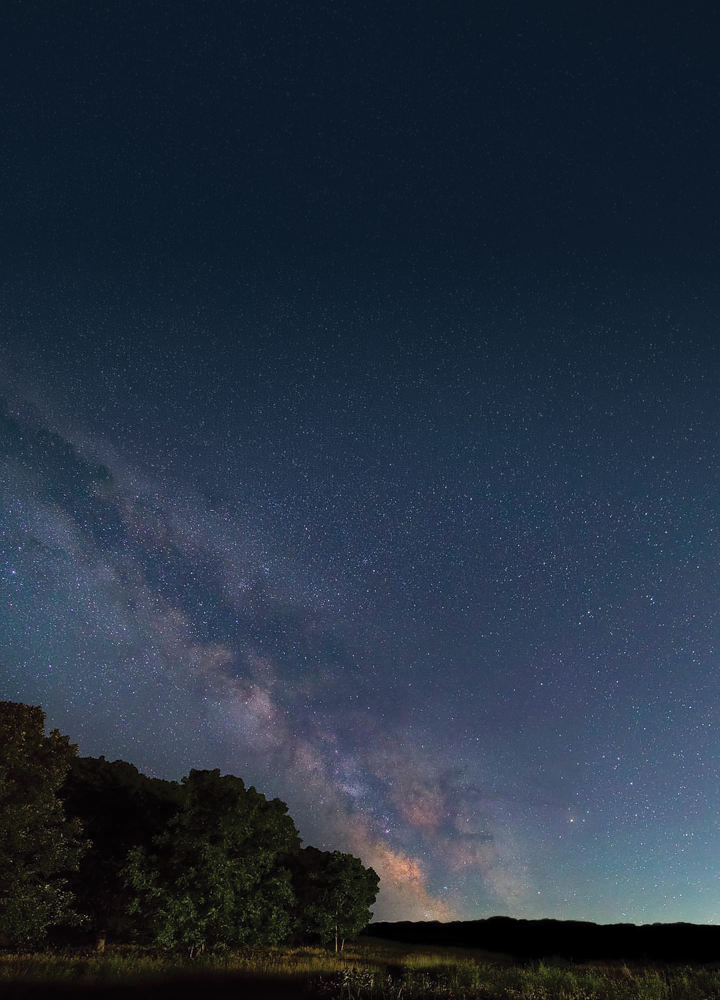
Today, visitors from all over the world think that darkness is worth seeing as they travel to this remote corner of Illinois to gaze at the stars and, under the right conditions, even see the Milky Way.
A bright idea
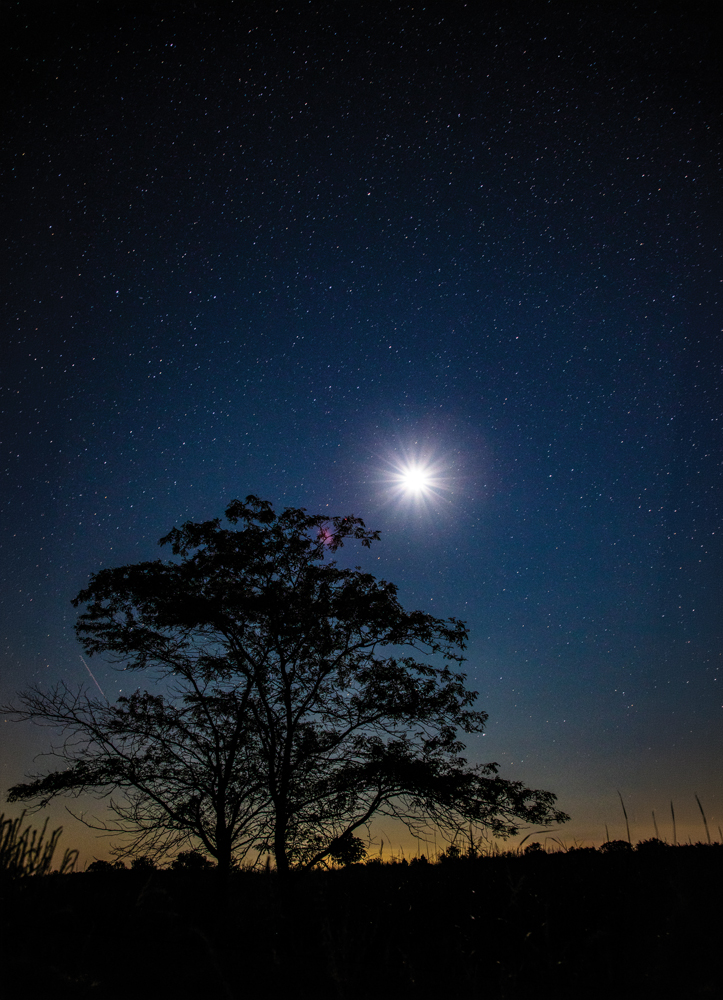
Located away from the glow of cities and towns and served by Eastern Illini Electric Cooperative, Middle Fork River Forest Preserve’s journey to becoming Illinois’ sole Dark Sky Park required an unusual conservation effort. Getting there started with an idea, and it wasn’t about simply turning off the lights.
“The sky is something worth preserving,” says Dave Leake, member of the Champaign-Urbana Astronomical Society (CUAS). “One could ask, ‘What’s the big deal about the Grand Canyon?’ Well, of course, it’s awe-inspiring. It’s amazing what nature has done. Well, to me, we have that same thing over our heads. It’s just that few people can see it these days with all the lights around.”
Leake has been looking up for most of his life. He caught what he calls the “astronomy bug” in fifth grade and eventually went on to study physics at the University of Illinois. His career took him to Parkland College, where he taught physics and astronomy and eventually became director of the William M. Staerkel Planetarium. He has since retired.
His involvement in astronomy also helped lead to the formation of CUAS, a nonprofit organization of astronomy enthusiasts dedicated to promoting interest in astronomy through public education, stargazing events and astronomical observation.
In the late 2000s, CUAS began holding star watches at the preserve. Members took sky-quality readings throughout Champaign County, and their measurements confirmed that Middle Fork was among the darkest locations in the county. Then a possibility emerged — could Middle Fork become an officially recognized Dark Sky Park?
DarkSky International was founded in 1988 to combat light pollution, and the organization’s International Dark Sky Places program, which recognizes communities and parks committed to preserving dark skies, began in 2001.
Leake first approached the forest preserve about pursuing a Dark Sky designation in 2012 but didn’t get far. He tried again a few years later after a change in leadership and, in 2015, was invited to explain the idea to the district’s Citizens Advisory Committee.
Sitting in the audience was Middle Fork Site Superintendent Matt Kuntz, who was closely following the discussion.
Leake explained that pursuing the designation would require changes to the preserve’s outdoor lighting, including replacing globe-style fixtures that scattered light in all directions.
“You mean I can finally get rid of those globe lights?” Kuntz remembers asking, and he was convinced.
Preserving the night
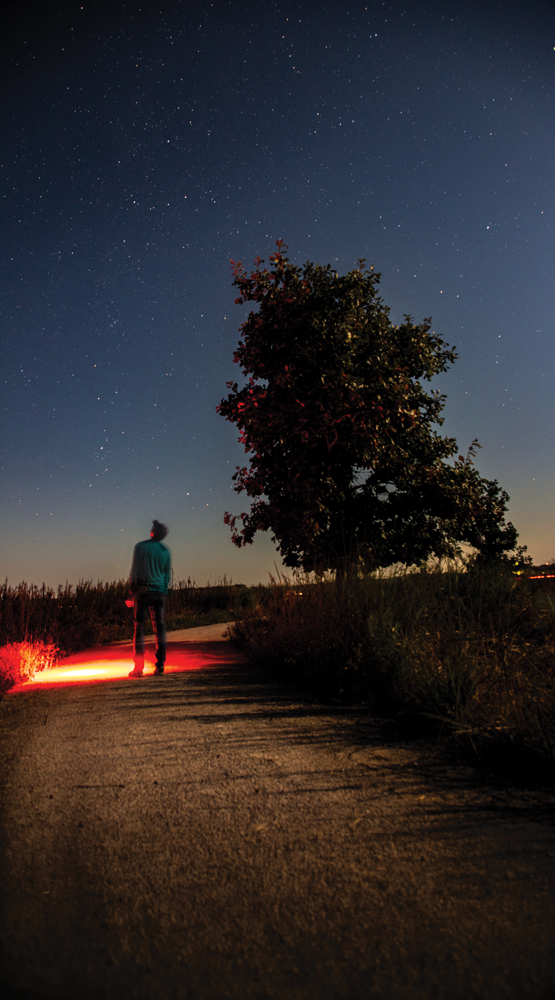
Kuntz studied conservation in college. He learned about the conservation of forests, prairies, rivers, streams and wetlands. But, he says, nobody talked about the sky.
“I was basically trained to stop looking after you got to the top of a tree,” he says. “It doesn’t matter after that. But the sky should be a big part of our conservation efforts as well.”
Middle Fork — which is part of the Champaign County Forest Preserve District, an agency dedicated to protecting natural areas in Champaign County — required a few upgrades to preserve the skies above. That effort started with replacing those globe lights.
To pursue the International Dark Sky Park designation, the preserve couldn’t simply remove its electric lights. As the operator of a campground and public recreation area, it still needed lighting for visitors.
This required some reconsiderations. They had to learn about lumens, light color and different types of fixtures that would direct illumination downward rather than allowing it to escape into the sky.
Fixtures were installed throughout the preserve and were recessed or shielded to keep illumination where needed. Kuntz describes it as more deliberate lighting.
That distinction is important to Leake. “Any light that shines up is not useful,” he says.
Kuntz understands the concern that can arise when people hear the word “dark.” As an operator of a campground, he’s responsible for visitors’ safety. It was never an option to turn off every light.
The project received community support, too. The Forest Preserve Friends Foundation helped raise money for the necessary changes, and community organizations provided letters supporting the designation.
After about a year and a half of work — including lighting upgrades, darkness level research, programming development and more — the preserve officially became an International Dark Sky Park in November 2018.
They came for the stars
Protecting the night sky has produced another unexpected result in Middle Fork. Visitors from all over the world have come to see it. There’s even a name for it — astrotourism.
Leake meets people from all over during CUAS star watches. And while the preserve doesn’t have a reliable way to count every visitor, Kuntz says campground revenue has increased at least 30% since Middle Fork received its Dark Sky designation.
“I never would have thought [they] would find us here in the middle of Champaign County,” Kuntz says of the tourists he’s met.
The uptick in astrotourists eventually created a problem — full parking lots and traffic jams. Kuntz had to figure out where to direct travelers who weren’t staying at the preserve’s campsites.
They needed a destination within the destination. His solution was the Dark Sky Trail complex. The trail, designed for visitors of all abilities, welcomes daytime and nighttime visitors and includes interpretive signage about dark skies.
An observatory built by the forest preserve houses a telescope provided with help from CUAS. It isn’t open for everyday public use, but it is used during staffed programs and special events.
The preserve also added 11 dark sky-friendly campsites, which Kuntz says are booked solid every weekend.
“It’s one of those great problems to have,” he says of the demand.
A view worth protecting
Earning the designation wasn’t the end of Middle Fork’s work. Maintaining it requires continued reporting, sky-quality measurements and public education. The preserve hosts dark sky programs and star watches. Astronomical events, such as meteor showers or lunar eclipses, draw visitors even when no program is scheduled.
For Kuntz, those visitors are reminders of why the effort matters. He grew up on a farm not far from Middle Fork. Seeing a star-filled sky wasn’t special. It was simply part of growing up in the country.
Only after working toward the Dark Sky designation did he begin meeting people who had experienced something entirely different. Some, he says, were in their 60s or 70s and had never seen a truly star-filled sky because of where they had lived.
Both men hope everyone has the chance to witness a preserved night sky and believe we all can play a part in reducing light pollution. “We’re not saying get rid of your lights,” Kuntz says. “We’re just saying adapt and change it.”
The good news is that protecting dark skies doesn’t necessarily require major changes. Homeowners, businesses and communities can consider whether outdoor lights are directed where needed or whether light is unnecessarily spilling upward.
Sometimes, Leake adds, more light can even be counterproductive. Poorly positioned security lights can create glare and hard shadows, making it more difficult to see what is beyond the illuminated area.
“Astronomy is in our heritage,” Leake says. “We get caught up with our phones and watch streaming television shows, but [when] you get outside, you realize there’s so much more out there.”
“I think people take the night sky for granted,” Kuntz adds. “I know I did.”
To learn more about Middle Fork River Forest Preserve or view its calendar of events, go to
champaignforests.org. For upcoming CUAS stargazing events, go to cuas.org/calendar. For more information about DarkSky International, visit darksky.org.