
An electric train set is a classic gift for kids. Along with building systems, dollhouses and board games, model railroads have been unwrapped for decades. Across Illinois, model railroaders tell how a love of a gifted train led to a lifelong pastime — and more.
“The train on Christmas is an entry point for a lot of people, but it’s a pursuit that many of us have taken beyond a toy train,” explains Steven Hamilton of Flora-based TAG Trains, a retailer of model railroading equipment at meets and shows throughout the Midwest.
Even working as a switchman and engine foreman for the Illinois Central Railroad could not quench Chuck McCabe’s love for hobby trains. He has shared that love as the owner of Chuck’s Depot, a hobby shop in Marion since 1994. “I started a layout at home, and I couldn’t buy the products I wanted locally, so I decided to put in a hobby shop,” he recalls.
The lower level of his shop is home to his own layout. “The basement is 64 feet long. That’s a scale mile,” he explains, talking about the basement layout that features dozens of engines and hundreds of boxcars, flatbeds and tankers, as well as railyards, communities and roads. “There are five tracks going the full length of that side — the main lines.”
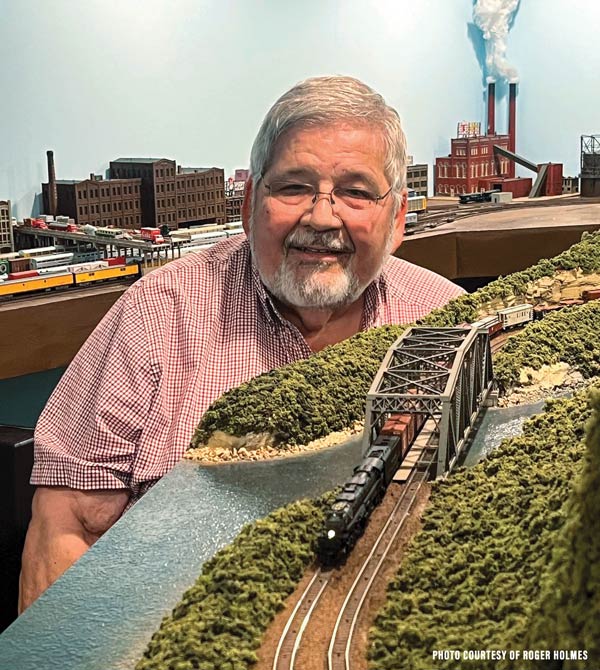
Springfield’s Roger Holmes also fell in love with model railroading as a child. He shares stories of his 4-foot-by-8-foot model railroad, which he started in an apartment while in law school.
“It has grown several times since then,” he says with a smile. “I’ve been in the same house since 1996, with a finished basement that is 13 by 21. When I ran out of space for my trains, I had more basement dug.”
Today, Holmes’ layout features a depiction of Chicago (complete with accurate models of skyscrapers and other landmarks), as well as a suburban setting and a rural community, just like the many throughout the Prairie State. Unlike his law school apartment’s layout, he can control this entire panorama and the trains on it from one device in the palm of his hand.
Complete control
Dave Macomber, president of the Burlington Model Railroad Engineers Society (BMRES), says the control systems, called DCC for digital command control, are a far cry from the hardwired transformers many kids had years ago. DCC is a computerized system where tracks are fully powered, and each engine has an onboard computer chip that decodes digital messages sent through the rails.
Signals are sent from portable handheld controllers rather than a lever alongside the tracks. Because each decoder has its own unique address, multiple trains can run on the same layout at the same time, each doing different things. DCC has added realism and functionality to model train layouts.
“The DCC is a little computer box and booster that puts current on the tracks, and there are little chips in the locomotives themselves that tell that particular locomotive what they need to use the power for — turn the lights on, go half-throttle, full speed or whatever,” Macomber says. “We have radio controllers that send signals to the locomotives to increase speed, decrease speed, blow the horn, ring the bell and turn on track sounds. We do all of that with the engines now.”
The system has revolutionized large-scale layouts like those operated by clubs. At these gatherings, hobbyists share their love of railroading and often develop extensive layouts. Macomber’s group, BMRES, is an example.
The club moniker comes not from the Burlington Northern Santa Fe Railway, which has lines not far from the group’s headquarters, but rather from Burlington, Iowa, where the club got its start. Today, this club has its own building on Western Illinois Electrical Coop. lines near Gladstone in Henderson County.
“We started out in Burlington, but when we lost our room in the back of a hobby shop, we actually were able to purchase a lot of land,” says Macomber, the club’s president, adding that club members built an 1,800-square-foot garage-like structure in 2001 specifically for model railroading.
He says club members gather every weekend to work on layouts and “run trains” on the five-level layout, adding that they have trains on tracks anywhere from 24 inches off the floor all the way up to 6 inches from the ceiling.
“For a club layout like ours, the DCC lets all of the members be their own engineers,” Macomber explains. “That means we have to have a centralized dispatch, so if you’re running your train around the layout, you have to tell dispatch where you are and where you are going because the dispatcher has to throw the turnouts (what you might call railroad switches) for you, or you won’t get where you want your train to go. We try to make it like the real thing.”
Home hobbyists appreciate DCC, too. Holmes says the newer technology brings with it more realism to layouts. “With digital command control, you can have multiple engines on the same track and control the speed of each, plus it gives you the opportunity for all of the sounds,” he says. “It adds a lot of interest and realism.”
While some enthusiasts are drawn to the logistics of dispatch, others just love watching and running the trains. Some hobbyists are fascinated by making the layout realistic. “With any model railroad club, there are a couple of distinct groups within the club,” explains Duane Imel of the Northwestern Illinois Model Railroad Club in Chadwick and JCE Co-op member. “One is the operators who like to run trains, and then there’s the modelers who build the layouts, build the scenery and tie it all together.”
Scales and eras
No matter what niche of the hobby they are drawn to, would-be model railroaders who take to the tracks must first decide which tracks. Model trains, rails and tracks come in a variety of sizes, known as scales.
According to the National Model Railroad Association, scales imply a “scaled-down” version of trains, buildings and accessories. A wide variety of sizes are manufactured worldwide, with a few more common in the U.S.
McCabe says he prefers what is known as HO scale, the most popular size of model trains. He says more HO trains and accessories are available than any other size, and the scale makes up 78% of all model railroading sales.
HO engines and rolling stock are 1/87 the size of the real thing — meaning a model track about 60 feet long equals a real mile of rail. To put it another way, most full-size diesel locomotives are about 16 feet tall; in an HO scale model layout, these engines stand about 2 inches high.
It is also among the most familiar model train scales. Many of the trains sold over the years by manufacturers such as Atlas, Bachmann, Life-Like, Tyco, Athearn and Walthers have been HO scale.
For those wanting something smaller, Z scale is a popular option. “Z scale is the most common commercialized small scale,” Hamilton explains. “It is very small, but you can fit a lot of layout in a briefcase.” Officially, Z scale is 1:220. One step up is N scale at 1:160. Hamilton says it is the second most popular model railroading size in the U.S. Holmes’ basement layout is N scale.
“I liked N scale from the beginning because it was smaller, and you can model much broader scenes. I can fit Chicago in a 13-foot-wide, 3-foot-deep space. There are probably 20 buildings in my Chicago area, whereas if I was in HO scale, there would only be eight or nine,” the retired circuit court judge says, adding that N scale allows for longer trains. “A freight train looks like a real freight train.”
Larger than HO is O scale. The popular Lionel brand of trains is O scale, which is 1:48, roughly twice the size of HO. With the increased size, O scale models offer more opportunity for detail, but, of course, these layouts take up much more space.
Hobbyists who want to take their railroad outside often lean toward G scale (think Garden scale), which varies between 1:20 and 1:32, depending on the manufacturer. A typical G scale boxcar is about 8 inches tall. These models are often developed for backyard layouts.
Many model railroaders also choose to depict a certain timeframe with their layouts. Some like the look of turn-of-the-century steam locomotives, while others select more recent decades.
“I generally see people modeling the so-called ‘Golden Era’ of the 1980s and ’90s, before all of the railroad mergers,” Hamilton explains. “There’s also a subset that’s modern. That’s what I do — model what I go out and see today.”
Details, details, details
Regardless of the size of the train and the era of modeling, for many enthusiasts, model railroading is all about the details. Hamilton says his mom, a crafting enthusiast, introduced him to the pastime. “She loved having the little buildings and trees and all of the details,” he recalls. “For her, the train was just an animated part of a larger crafted thing; for me, I was enamored with the trains.”
His fondness for trains extends to real railroads, and Hamilton says he often watches trains go down the line before turning to his own layout. “I will often observe real railroad operations, and then come home and try to replicate some of the details of what I saw on my model,” he says.
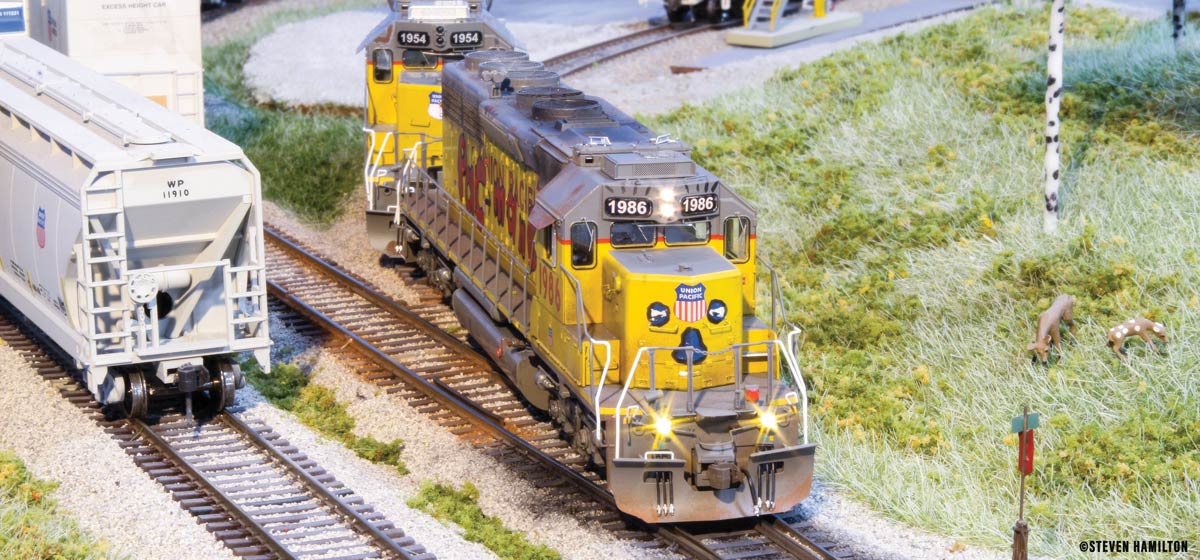
Sometimes it is nearly impossible to distinguish model railroad layouts and trains from real ones. Some hobbyists’ creations are detail-driven: Train cars are customized to look dirty, weathered and old; some, like real rolling stock, even feature graffiti. Highways in layouts are complete with construction zones, patches and potholes; electric lines scatter from transfer stations, and modeled industrial areas are complete with piles of scrap and even litter.
Other hobbyists go even further. “There are individuals in the hobby,” Hamilton, a member of Wayne-White Counties Electric Cooperative, explains, “who are so expressly detail-oriented that they’ve been given the nickname of ‘rivet counters.’ They want a model to be 100% accurate — not just to the type or model of a locomotive, but to the exact accuracy of a particular cab number of the original from the real world, right down to the number of links in the chain on a railing to the style of window wipers.”
The advent of 3D printing is giving many model railroaders another option for designing accessories and layouts. Hamilton says that a wide variety of landscaping and models are also available commercially for those who are hesitant to design, paint or craft their own.
“This is one of those hobbies where you can learn all sorts of skills that apply to other areas of your life,” Hamilton explains. “Through model railroading, I’ve learned electrical, computer programming, carpentry, civil engineering, a little bit of machining, and, of course, art.”
Enthusiasts recommend those thinking about model railroading do some research. Hamilton says the National Model Railroad Association has numerous resources on its website and can lead one to clubs and clinics nearby. He also suggests YouTube to see what is possible in model railroading and learn some basics. Of course, finding clubs and individual hobbyists is a great way to start as well.
Holmes says the appeal of model railroading is simple: “It’s the chance to create and be the master of your own world in your own basement,” he says, adding that model railroading offers something for everyone.
“We have a lot of great modelers,” McCabe explains. “It’s people from every industry and occupation — doctors, college presidents, lawyers, mechanics, laborers, every type of industry. This is a release for people,” he says.
Hamilton adds, “We’re seeing people from all walks of life, men and women, old and young, from all over the world, and that is encouraging. I’m always meeting people who are into model trains. Model railroading is very much alive and well.”