
Flying about 300 feet off the ground, Dan Gerard took in a view of Illinois that not many people get to experience. Feet dangling into open air from his seat with a propeller strapped to his back, he thought he was alone — until he looked to the right and realized a bald eagle was gliding along with him.
He says that was one of the coolest experiences he’s had while enjoying his latest unconventional hobby — paramotoring. “Being able to fly at high altitudes and see the countryside and just take it all in, it’s just an escape for me,” Gerard adds.
He isn’t alone. Paramotoring is taking off among thrill seekers as it grows in popularity. The sport is a close cousin of paragliding, a motorless free flight utilizing elevation (like a slope or hill) and thermals (rising warm air) to get off the ground. Since a change in elevation is in short supply in Illinois, a small engine and propeller are necessary for pilots like Gerard to lift off.
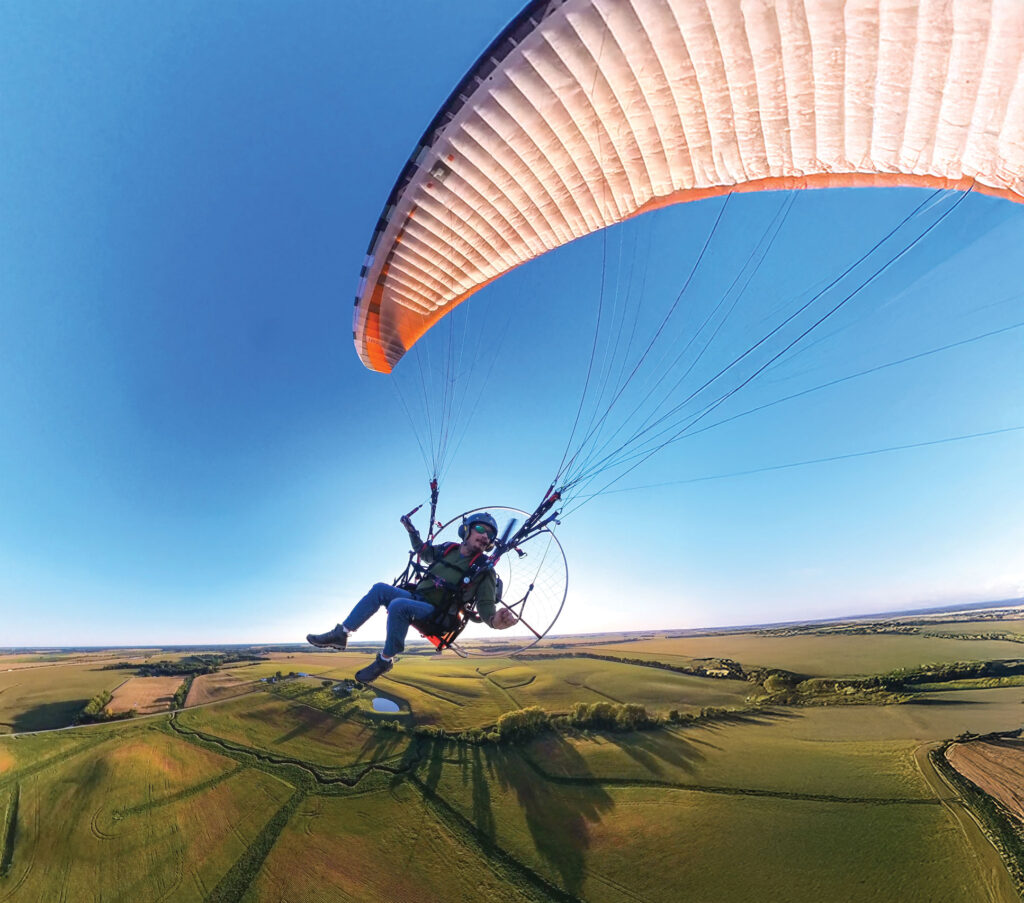 “Paramotoring is typically more common in flatter states, where we don’t have mountains to run and jump off of,” Gerard explains. “In Illinois, we’re pretty fortunate where there’s just so much open land and you can just go and have fun.”
While paragliding often requires midday, thermic conditions, which can be turbulent, paramotor pilots aim for calmer air in early morning or the evening. “We typically fly during the two hours after sunrise, two hours before sunset,” he says. “We get to enjoy the nice, smooth, clean, fun air.”
At first glance, it may look impossible — and maybe a little awkward — for a paramotorist to get off the ground. The colorful wing is laid neatly on the ground, the pilot straps on the motor and propeller, and finally the pilot turns on the motor and starts running until their feet leave the ground.
“You are literally running into the sky,” he explains. Gerard, who is the chief technology officer at the Association of Illinois Electric Cooperatives, began his paramotoring journey with a YouTube video.
“I watched a video of a guy flying to McDonald’s,” he recalls. “That was about five years ago, and I knew as soon as I saw it that I had to try it.”
Part of the appeal is accessibility. Paramotoring doesn’t require a traditional pilot’s license, and the cost of entry is relatively low compared to other forms of aviation.
“The barrier of entry to get into aviation was relatively low with this type of sport,” he says, adding that self-teaching is technically allowed, but training is strongly recommended. “Get training. This is not something that you should try and accomplish on your own. You don’t know what you don’t know, and it is aviation. You are taking your life into your hands.”
 Gerard attended a flight school and earned certification through the United States Powered Paragliding Association. His first taste of flight came without a motor.
“They tow you up to probably about 300 feet, and then they cut the rope, and you float down,” he says. “That was my first experience with flight.”
Eventually came the moment every student waits for — the first solo flight. “I remember getting about 60 or 80 feet off the ground, thinking, ‘Okay, now I’m in the air, and now I have to get back down somehow,’” Gerard laughs.
During that first flight, he remembers his instructor sensed his unease over the radio and said, “I need you to stop, breathe, and just take everything in for a few minutes.”
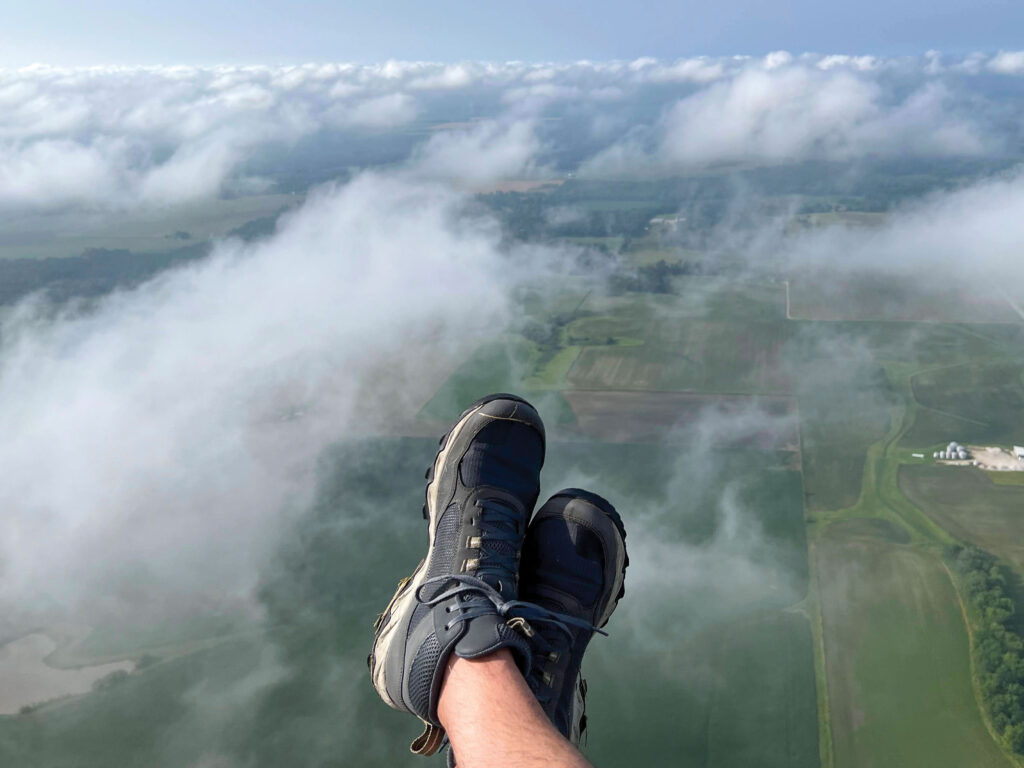
Once he relaxed, the experience changed completely. “It was indescribable,” Gerard recalls. “There’s something different about your feet just kind of dangling in the air and flying 700 feet off the ground.”
For new pilots, the mental challenge can be just as intense as the physical one. “I think the hardest thing to do is trust your gear, because you’re literally just hanging by a few strings and a harness,” he says.
Flights depend heavily on weather, especially wind. Ideal conditions are gentle. And while flight is more common in warmer months, Gerard has flown in Illinois every month of the year.
“The ideal wind conditions would be between 3 and 8 miles per hour,” he says. “We really don’t want to see the gusts go above 10 or 12 miles an hour.”
Before every flight, he checks multiple weather apps and reviews conditions not just at ground level, but at altitude as well. In the air, most pilots rely on a tracking app. “It records our complete flight path, our speed, our altitude,” he says. “It gives us notifications if there’s manned aircraft in our vicinity.”
Altitude itself is a tradeoff. According to Gerard, flying higher gives pilots more time to react if something goes wrong. So, the higher the altitude, the safer you are. Despite that, he enjoys lower altitude flights the most.
“I have the most fun flying a couple feet off the ground, cruising over the countryside and hopping over trees,” Gerard says.
That low flying comes with responsibility. Power lines, in particular, demand attention. “Power lines can actually be really hard to see, early morning, late evening,” he warns. “You really have to look for the poles.”
Paramotoring has multiple safety layers, including a reserve parachute. “The biggest safety feature that we have is our reserve,” he explains. “If something goes wrong, I can always reach down and deploy that reserve.”
From startling deer to seeing kids pointing and waving, flying never gets old to Gerard. “It’s definitely peaceful. It’s very calming,” he says. “It’s surreal that we can even do this sport.”
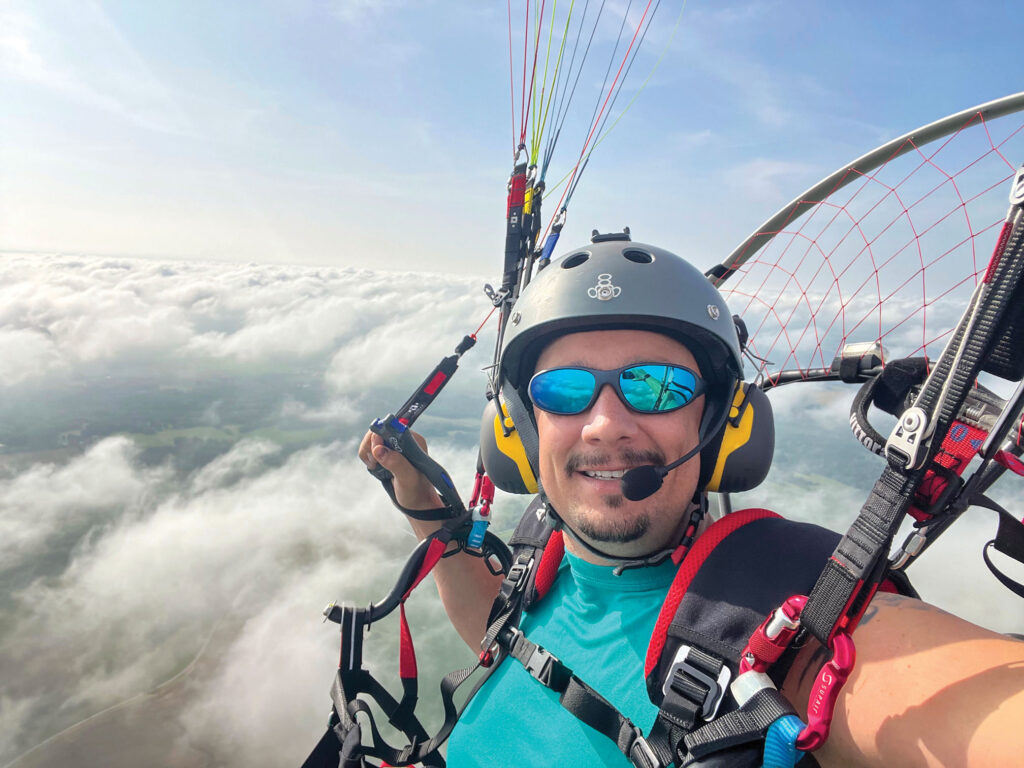 Oftentimes, he will bring along a few toy paratroopers on his flights to toss to any kids he spots below. “If I see kids out in the yard, I’ll usually try to fly by and drop some parachute guys for the kids,” he says. “The kids always seem to love that.”
While paramotoring isn’t a mainstream sport (although there are professional competitions), it has a dedicated following. “It’s not a huge community, but there is a community,” he says. Pilots gather at fly-ins across the country, including events in Illinois. For newcomers curious about the sport, many qualified instructors offer tandem flights.
For those interested, there are several fly-in events in Illinois. Airborne Adventure of Illinois, a paramotor training school located at Percival Springs Airport and Campground in Watson (outside of Effingham), hosts multiple events throughout the year. The KornBuzzard Fly-In is scheduled for June 11-14 in Palmyra at Zelmer Memorial Airpark.
Gerard has a flying bucket list that keeps growing. His priority right now is flying a coastline, and he has dreams to someday fly over the Pyramids of Giza in Egypt.
“If you’ve ever had the dream as a kid [where] you run around with your arms out and wish you could fly, it’s pretty much living that dream,” he says.