
During the winter holiday season more than a decade ago, twin sisters Mindy and Missy Dalgarn were standing in line at what was then the Galena State Bank. While they waited, the sisters took in the local angel tree, bedecked with the gift requests of local children and families in need of assistance. Reading their requests, Mindy and Missy were shocked to realize that many people in the community weren’t asking for the type of presents typically found under the tree.
“We were surprised, and quite frankly, saddened by the number of people, both men and women, between the ages of about 25 and 85, who were asking for cleaning supplies for Christmas,” says Mindy, who is a JCE Co-op member. The sisters felt compelled to investigate the situation further and reached out to community leaders. “Missy presented a proposal to the president of Elizabeth and his directors, and they were very encouraging.”
That proposal outlined the Dalgarns’ plan to diminish the need they had witnessed through the formation of a nonprofit, much like a food pantry, that would provide friends and neighbors with the basic cleaning supplies they needed. The sisters were offered a small space in a local school, just 8 feet by 13 feet, and in 2014, Missy and Mindy opened the doors to The Mop Shop.
“We were there for nine years, and it worked out well. We were right next to the [Elizabeth] Food Basket, so it was kind of a one-stop shop for our clients,” explains Mindy. The nonprofit eventually outgrew the space, however, and, in 2023, moved to a new location inside Lord of Love Lutheran Church in Galena.
“We opened with 20 clients representing 34 family members, and we now [have] 1,961 clients and family members from 10 communities within Jo Daviess County,” she adds. “There’s a growing need, and it’s increasing, as you can imagine.”
The Mop Shop’s reach has been fueled through conversations with and support from civic leaders, local business owners, friends and neighbors. “It’s just evolved,” says Mindy. “We look to help people and encourage people in other communities, in other counties, to start to think about establishing mop shops. Right now, we have three rooms, [but] we didn’t start that way. We started with two little shelving units [and] grew it depending on what our clients needed.”
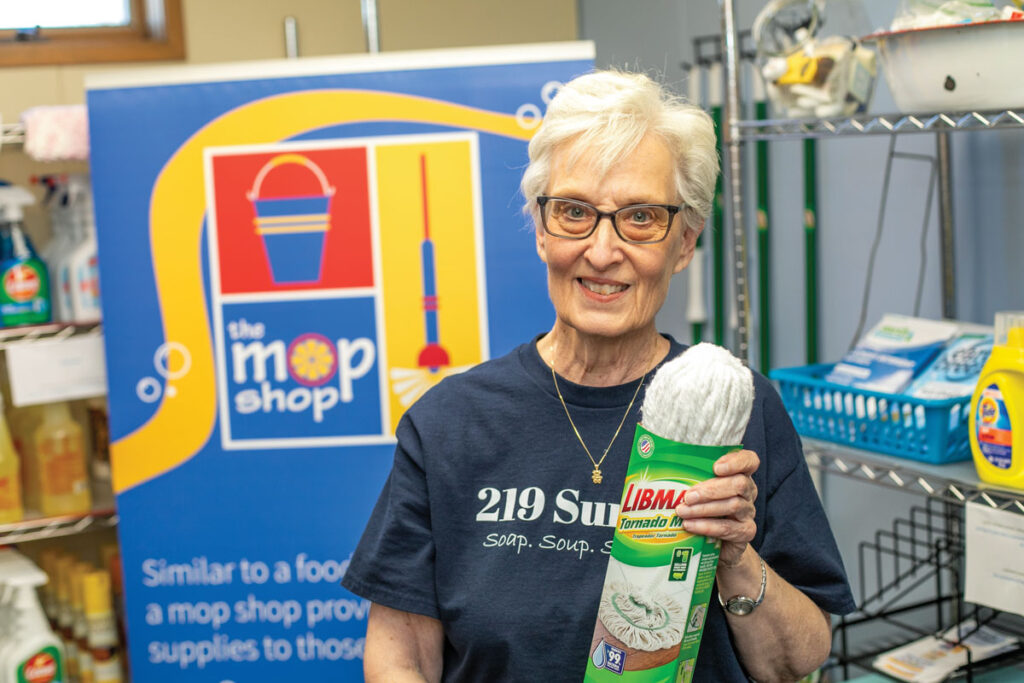
Products most in demand include items often taken for granted, like paper towels, disinfecting wipes, dish soap and laundry detergent. The Mop Shop also carries everything from multi-surface cleaner and furniture polish, garbage bags and baking soda to fabric softener, toilet bowl cleaner and glass cleaner — and, of course, mops, brooms and buckets, among other items. Verification of need is not required of clients. “If an individual says they’re in need, they’re in need,” explains Mindy.
Nia McCarthy, a client, heard about The Mop Shop from her neighbor and has been going there for more than a year. “Believe me, living on my own at 74 years old, you know, with prices the way they are, they’ve been a godsend,” she says. “They treat everybody the same, [with] compassion and empathy and respect. Some people who go there are in really dire straits, [and] they’re not made to feel any less of a person.”
Jan Hoedebecke, a volunteer at The Mop Shop, was enamored of the concept when she first heard about it. “Making your home a warm and safe and welcoming place just means a lot,” she says. “You hear about food banks, and even though that’s still a tremendous need, this was a niche that just kind of spoke to me. I said, ‘This is something that we can really build upon, and I’d love to be a part of it.’
“There are so many people who are tucked away, and you don’t see them, and they just need a little help,” adds Hoedebecke. “It’s just heartwarming to see the humanity in people, no matter where they are on the socio-economic scale. They’re lovely people, and I’m so happy we can help them.”
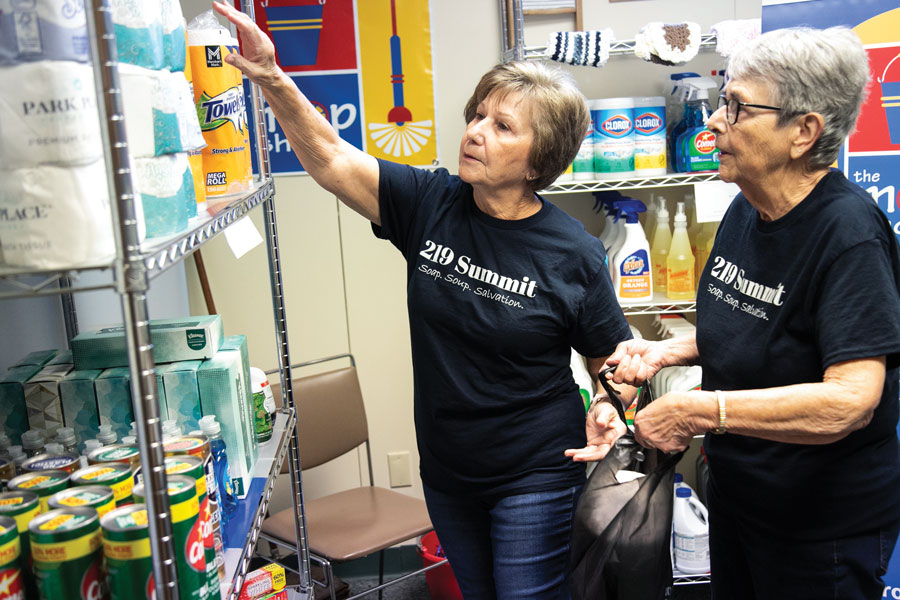
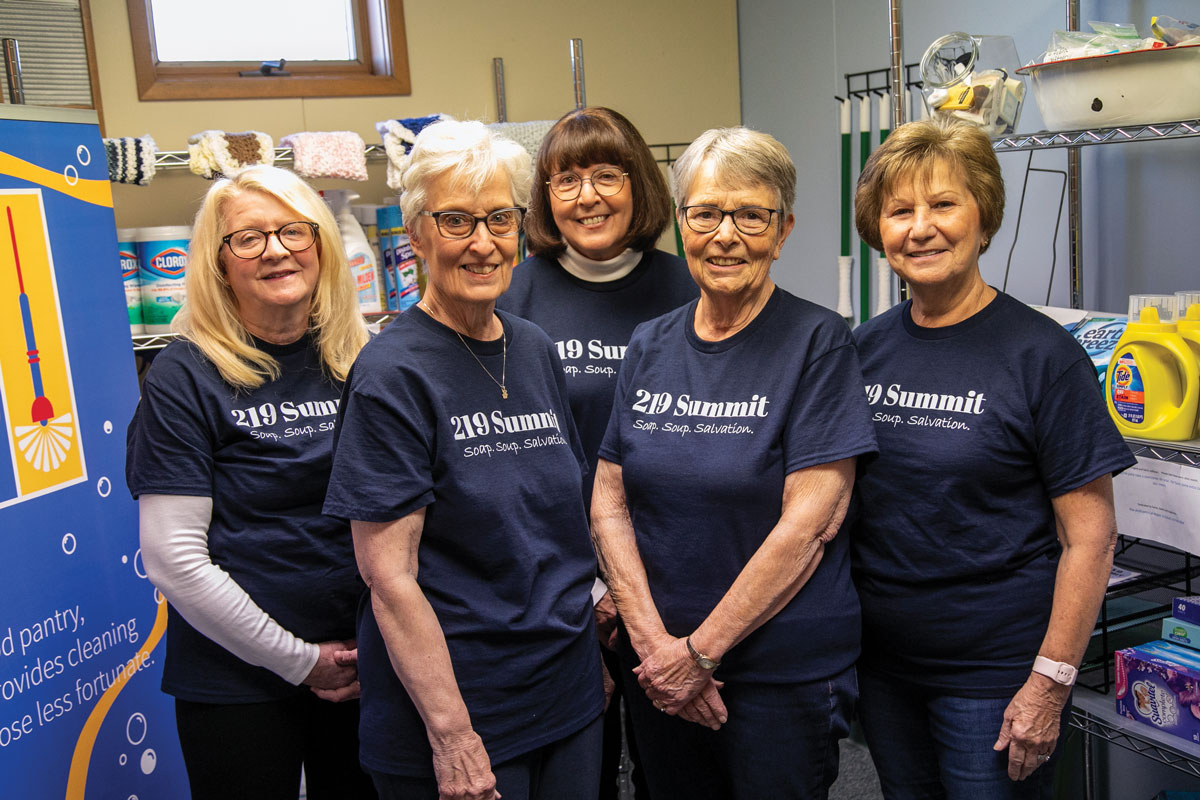
Mindy believes the most important role of volunteers is serving as ambassadors within the community. “Spreading the word, developing relationships with not just our clients and not just our donors … but with the community at large, is incredibly important,” she explains. “I spend a good deal of time working to cultivate those relationships and recognize people for how they help us and how they help our community. … I want people to know that we couldn’t do what we do without them.”
According to Alana Turner, a local business owner and Mop Shop donor, the work of the nonprofit brings along with it a client’s pride in his or her home. “Just having a cleaner home allows you to be healthier every day,” she says. “It allows you to feel good about yourself each day.”
Turner felt led to contribute through her Galena business, Poopsie’s, a unique gift shop whose mission is to create joy through service. “One way is partnering with places like The Mop Shop and helping them move into different areas that they’ve never dreamed of,” she explains. “Over the last number of years, we’ve committed to giving 1% of our sales back to regional charities.”
People have supported the cause in many creative ways. The owner of the local Piggly Wiggly has donated cases of product since the beginning; Jo Daviess County Transit provides transportation to clients who need it; and Kreider Services delivers prepackaged bags to individuals who are unable to come in person due to health constraints, to name just a few.
Pastor Robin Luckey of Lord of Love Lutheran Church, JCE Co-op member and home to the nonprofit, says there are multiple points of connection between church members, volunteers and the community, explaining that one of those connections led to sharing an area of their building.
“It’s a space in Galena that’s well known to people. It’s right next to the nursing home, and it’s adjacent to the food pantry,” she says. “There are a lot of crossover clients who come to Welcome Table [a bimonthly free lunch program] and find out about The Mop Shop and vice versa, so it’s a natural fit. They dovetail well.”
Luckey agrees with Turner that The Mop Shop provides its clients with a sense of dignity — as well as a source of connection.
“It brings us dignity to care for our homes or our apartments or our dwellings,” she explains. “[The Mop Shop has also] become a social gathering for people … folks look forward to it. Relationships have been formed … people don’t just come in and get their stuff and leave.”
There are a few things needed to make an endeavor like this one a success, says Mindy — space, dedicated volunteers, generous donors, leadership and community support. “Everybody applauds the concept, no question. Great idea. But you need those ingredients,” she elaborates. “Fortunately, we’re in a place where we have it in abundance.”
Though her sister Missy has since passed, Mindy continues their mission. “Our goal, from the get-go, was that this would be the first mop shop, and they would spring up and become as prolific as food pantries are. We thought, ‘How hard can it be?’ I mean, if we can do it, every community should have a mop shop,” she says.
Mindy’s guide to starting a mop shop
Step 1
Identify a space that is available at no or low cost. Consider an open room in churches, schools, community buildings or even shelves in an existing food pantry. Be especially sensitive to the possible needs of potential clients: seek space that allows easy access to the building — a first-floor location is recommended, along with parking and a limited number of steps. If there’s a bus stop nearby, all the better. Remember, start small and grow your program.
Step 2
Share your plan with friends, family and neighbors. Ask to speak at churches, civic organizations, athletic leagues, etc. Submit stories to local newspapers and magazines. Request interviews with local radio and television stations. Post notices in local banks, grocery stores, thrift shops, laundromats, hair salons and gas stations.
Step 3
Identify those who support your efforts and are eager to serve as volunteers. You may be surprised how many people are interested as the word spreads. Note that volunteers serve as community ambassadors. Communication with them is essential to your success. Make certain they are well-informed.
Step 4
Gain support from area churches, banks, businesses, civic organizations, athletic clubs and youth groups such as school clubs, 4-H, etc. Collect cleaning supplies through donation drives. Always acknowledge gifts from those who support your efforts. This is critical — thank-you notes to donors go a long way. Word spreads, relationships develop and community support grows quickly.
Step 5
Keep your eyes open for sales. That should be your modus operandi as you prepare to stock and restock your shelves. Look for bargains and work to develop relationships within your community.
Step 6
Seek out grant opportunities.
For more information, visit themopshop.org or contact Mindy at 815-281-1995.