
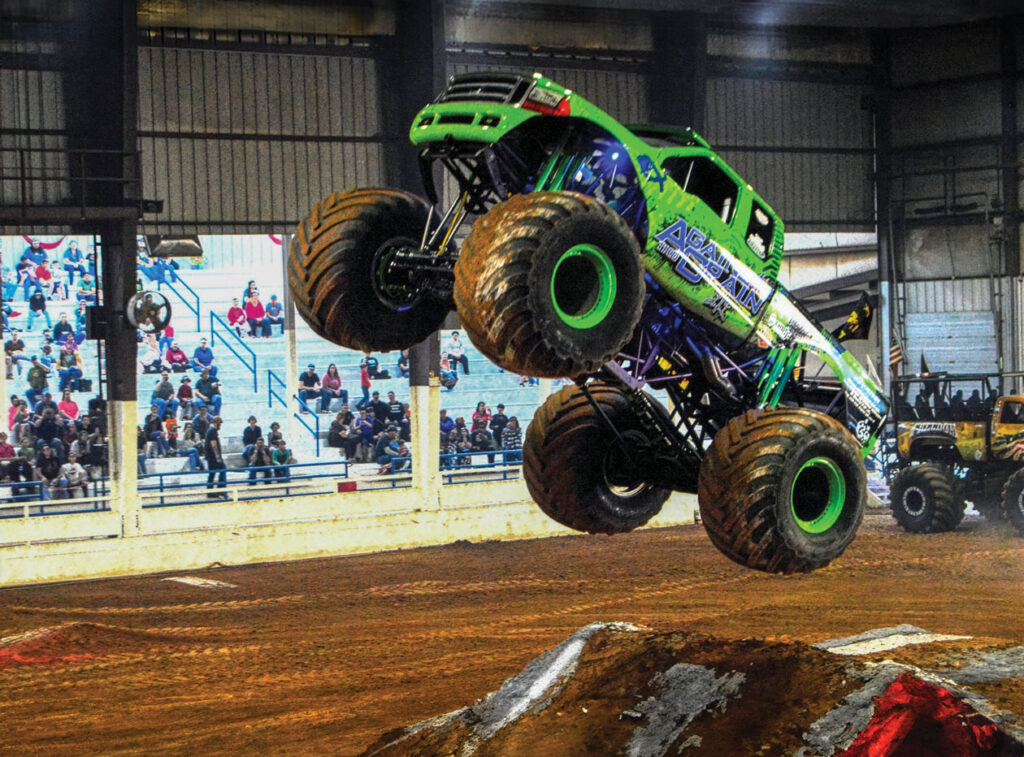
Even by stretching up and standing on the tips of his toes, Rich Inman couldn’t reach the top of the tires. Still, he was enthralled, not just with the wheels, but with all that his 8-year-old senses were absorbing — the thunderous rumbles, the gleaming metal, the smell of energy hanging in the air and the all-encompassing ambiance of power.
Nearly four decades later, he remembers being too excited to sit in his seat in St. Louis’ old Checkerdome, he was so enamored with the super-sized pickup trucks on the arena’s floor.
“When those trucks came out, I thought, ‘Holy cow! That’s what I want to do,’” Inman recalls. “It’s been my passion ever since.”
He got his start in the early 1990s, working on one of the first monster trucks before purchasing a “ride truck” (a truck built to carry passengers eager for the monster truck experience). Inman then built his own competition-ready monster truck, which he later sold.
The truck’s new owner reached back out to Inman, asking him to build some spare parts. The rest, as they say, is history. Today, Inman’s Concussion Motorsports is a leading manufacturer of chassis, parts and components for monster trucks.
Big trucks, big business
Legend has it that monster trucks began when Bob Chandler started modifying his 1974 Ford F-250 pickup truck in Missouri, not far from the St. Louis Checkerdome. Within a few years, the changes to the pickup were so extensive that his truck — called Bigfoot — was regarded as the first monster truck.
Modern monster trucks feature four-wheel drive, four-wheel steering, high-horsepower engines, full roll cages and elaborate suspension systems. Yet, monster trucks are more than modified vehicles; they are an industry unto themselves. Monster Jam, the nation’s largest organizer and promoter, reports more than 4 million attendees at more than 130 events annually, and it’s estimated that the company generates nearly $2 billion in revenue.
Not only are many of the behemoth vehicles built in places like Inman’s Randolph County shop, but fans across Illinois flock to monster truck events, where they often can cheer on drivers hailing from the Prairie State.
Sometimes events are simple exhibitions where monster trucks traverse jumps and tight corners, crushing junk cars in their path. Most, however, are races where drivers compete against one another in heat-style brackets or run against the clock to complete designated courses in the least time.
Trained as a welder, Inman knows the business from the inside out. Before turning his attention to turning wrenches full-time, he was behind the wheel of some of the most recognizable monster trucks on the competition circuit: Bigfoot, Monster Patrol, Extreme Overkill and Shock Therapy.
A neck injury keeps Inman from driving monster trucks competitively now, but his focus is on keeping others’ big wheels rolling. Bumper to bumper, Concussion Motorsports manufactures everything for monster trucks.
“Everything that’s fabricated on a truck, we build,” Inman explains. “We even do some turn-key trucks; when we’re done with them, they drive right out of the shop and can go straight to the show. We build everything in-house.”
Inman and his team have built a couple of Bigfoots, worked on “Grave Digger” and were behind the “Cadaver” truck, a special project for television’s Jesse James of “West Coast Choppers” fame.
While the big V-8 engines are at the heart of these giant vehicles, the heartbeat of monster trucks also pulses from central Illinois. Just north of Champaign and a couple of monster tire rotations from Interstate 57 is the Hall Brothers shop. Here, brothers Mark and Tim Hall oversee, well, a monster monster truck business.
“We started in 1987 with four-wheel drive trucks, going to mud races,” Tim recalls. “Back then, you would drive to the races in your truck, race, and hope you didn’t tear it up so bad you couldn’t get back home.”
He says one thing led to another, and they found themselves building bigger and bigger trucks and traveling to events most weekends. “We thought it would be pretty cool if we could make a living doing this, and here we are, 40 years later, still out on the monster truck circuit with more trucks.”
They landed a local sponsor in 1987, then, a few years later, Chrysler’s Dodge Division reached out to promote Ram trucks through their operation. The Hall Brothers and Ram continue their partnership. Tim calls it one of the longest business relationships in motorsports.
Today, the pair has a fleet of monster trucks and a convoy of tractor-trailers to haul them. They have even specialized in their own roles — Mark does the welding and fabricating work and serves as one of the team’s drivers. Tim, who drove one of the team’s trucks for several years, now handles all the business aspects and serves as crew chief, specializing in transmissions and suspensions.
“My driving experience gives me a little bit of perspective, so I’m able to know when something’s going on,” Tim says. “I can see things from the sidelines and understand what the drivers are telling me. It’s helped.”
It certainly has. As a driver, Mark won 26 national monster truck series titles (a couple of Hall Brothers’ other drivers also have championship titles), and they are enshrined in the Monster Truck Hall of Fame.
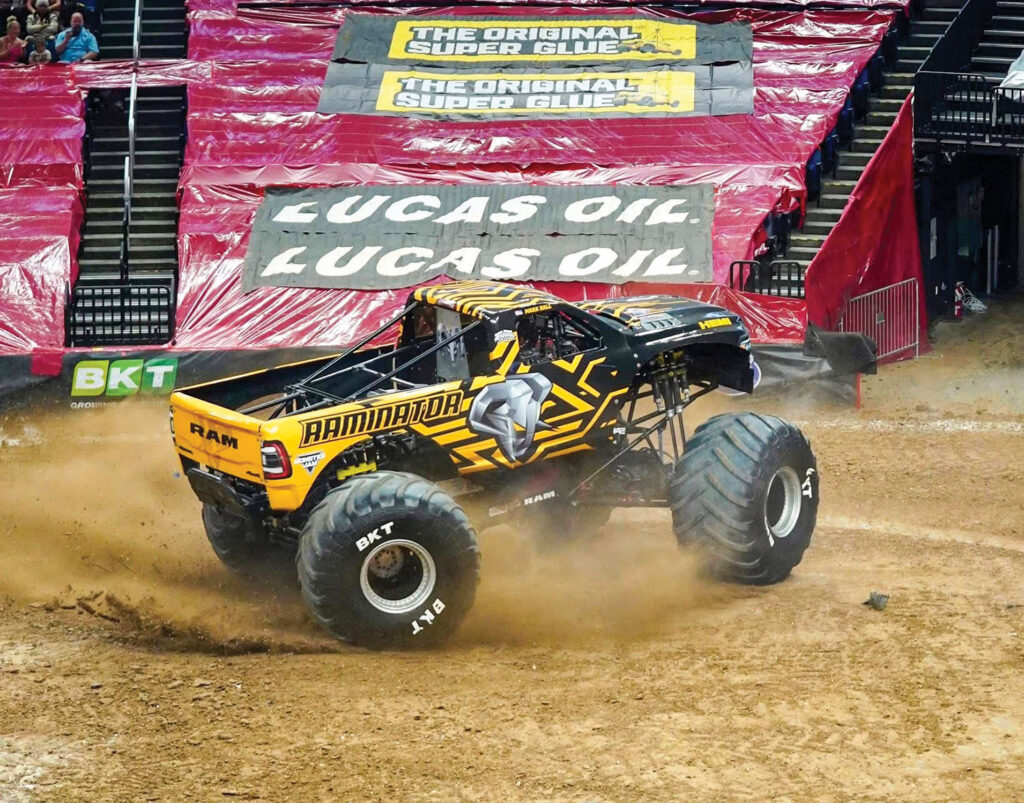
Tim compares the operation to a multi-car NASCAR team. They currently have four racing trucks (including the flagship “Raminator” and “Ramdemption”), two show trucks that exhibit primarily at Ram events and dealerships and one ride-along truck, like the first monster truck Inman owned.
Behind the wheel
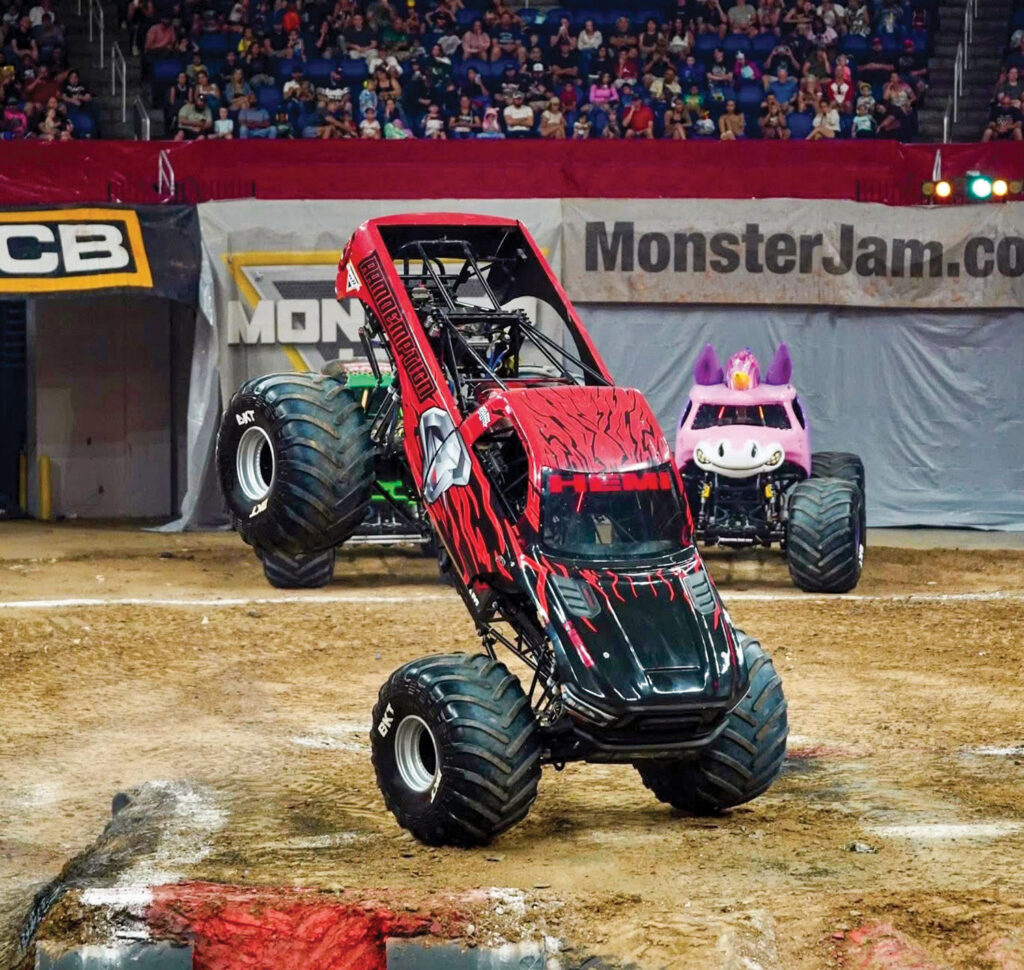
Ask the Halls or Inman, and they’ll tell you building a monster truck is a big job, but driving one of these beasts is, to say the least, challenging. First, drivers have to climb up — not in, but up — to strap into a race-car style seat and buckle into head and neck support braces.
And, while the trucks may look like new pickups on the dealer lot, they’re not even close. First, these trucks run on methanol, not gasoline or diesel, and they boast nearly 600 cubic inches of displacement in supercharged aluminum V-8 engines.
The custom suspension system features 26 inches or more of travel — much more than standard shock absorbers. Even the steering system is souped up, with hydraulic-controlled rear steering that allows the rear wheels to “crab steer” (turn in the same direction as the front wheels) or turn in the opposite direction, making for extra tight turning.
So, is there anything on these trucks that matches the pickups you can buy? “Yes,” Tim admits. “The emblems.” The sticker prices aren’t similar either. He says each monster truck is valued at upwards of $350,000. But the real difference is in driving one.
“Driving a monster truck is pretty fascinating,” Tim shares. “You really don’t have a lot of vision. Imagine having a 6-foot-tall guy standing right in front of you and not being able to see him. … You must anticipate when you’re going to hit the jumps. It’s really amazing how these guys can drive these things at such high speeds and with such precision.”
Tim knows about the speed. His brother Mark has been listed in the Guinness Book of World Records with the fastest speed ever in a monster truck: 99.1 mph.
“These trucks run remarkable speeds, especially when you consider that they weigh 11,000 pounds, and they’re built to run in football stadiums and hockey rinks,” Tim says, adding that track conditions are never the same. “The drag strip is always the drag strip, and NASCAR has specific cars for specific tracks. We don’t have that luxury. We have to be able to adapt. We might be running 50 feet this week and 500 feet next week. Maybe there’s big jumps, or maybe they’re little jumps. We have to tune the little things and make it all work wherever we are.”
Then, after every weekend, it is time for more tuning and more fixing. He says trucks undergo a top-to-bottom inspection, so that teams can “get ahead of failures.” He adds that they look at every piece of the truck, looking for wear, cracks and anything that could be the difference between winning the following week and a breakdown.
The appeal
Just as Inman was mesmerized by monster trucks as a youth, the large machines garner a lot of attention and appeal to a broad audience. “They’re just larger than life,” Inman says. “They’re loud, and people love demolition derbies, and this is what the trucks are all about. Every time one of them goes out, people — especially kids and ‘big kids’ — love them.”
Tim adds, “I think anyone who has ever been stuck in a traffic jam has wished they could just drive over the other cars. It’s that feeling.” He says monster trucks encompass a variety of motorsports, comparing it to a mix of circle track racing, drag racing, demolition derby and motocross.
“It’s fun watching what the drivers can do with these trucks and how they almost crash regularly but avoid them. The challenge of what they do is some of the appeal,” Tim says.
Against the Grain
One of those drivers is Brad Shippert. Like many others, he grew up watching monster trucks and always said he wanted to drive one but never had the opportunity. That is, until life shifted gears.
After losing his first wife to pancreatic cancer and later battling through his own chronic myelogenous leukemia followed by a stem cell transplant, the Lee County farmer decided to, in his words, “chase the dream.”
He purchased the former “Big Dawg” monster truck and opted to take the vehicle down a unique path — with an approach to monster trucks that differs from most others. For him, monster trucks are a vehicle to share a positive message of hope and family, packaged with faith and farming. The result is the “Against the Grain” truck, which reflects his way of doing things differently.
“Through the monster truck, I can tell my story and my testimony,” he says. “How many people can say that they went through cancer and now are driving a monster truck?”
Shippert drives his monster truck when he’s not behind the wheel of a tractor, combine or grain truck. His 1,000-acre grain farm is his primary enterprise. The truck comes second, but it’s more than a hobby.
“It’s a job. I treat it as a business because you can’t play around with it; there’s too much involved. ‘Against the Grain’ is a brand, and we’re trying to build it up, saying, ‘Hey, we’re doing something different by being outspoken about our faith,’” he explains.
“Something different” means you won’t find Shippert on the Monster Jam circuit. “That’s not the scope we want to operate in. With the farm and my family, I don’t want to be gone every single weekend,” he says.
Those weekends when he does travel with the truck, you may find him at competitions, sometimes at festivals and often doing static displays or fundraising events. He adds that when he’s not repairing agricultural equipment, he’s working on the truck. It’s hard work, but he says he really enjoys it.
“The real fun of this isn’t necessarily driving the truck,” he says. “When you drive, you’re getting slammed around. You’re in a fire suit, you’re hot, and it’s not the most comfortable thing in the world. The real joy is seeing how kids light up when they see these trucks. It’s the size, it’s the color, it’s the loudness, it’s this massive thing that they see doing extraordinary things that’s just mind-boggling.”
Weekend after weekend, drivers like Shippert are wowing crowds, and they aren’t slowing down. In fact, Inman says he thinks the industry will continue to rev up.
“The trucks are just going to keep getting bigger and louder,” he says. “Any old monster truck guy will tell you that they thought they’d only have a job for a little while and that monster trucks were going to fade out, but that’s far from the case. There’s just no end in sight.”