
The migration is an annual event. As summer molts into autumn, these birds of flight fill the western Illinois skies just as they have for decades. While they may sport different colors, they are all the same breed. These are Stearmans, biplanes of a bygone era, arriving in Galesburg for their annual National Stearman Fly-In.
It all started in 1972 when two Stearman enthusiasts, Thomas Lowe and Jim Leahy, organized a gathering of 27 biplane pilots in the Knox County community. Over five decades, the National Stearman Fly-In has evolved into a pilgrimage of sorts, for not only pilots of these classic airplanes, but also for other devotees of the mid-century aviation trainers.
Stearmans — officially known as the Boeing Model 75 — are dual-winged, open-cockpit aircraft developed initially to train U.S. Army Air Forces and U.S. Navy pilots before World War II. Adapted from a design by Lloyd Stearman in the early 1930s, the plane evolved into a primary trainer not only for the U.S. military but also for the Royal Canadian Air Force, as well as aviators from other nations. More than 10,000 Stearmans were built in the 1930s and 1940s.
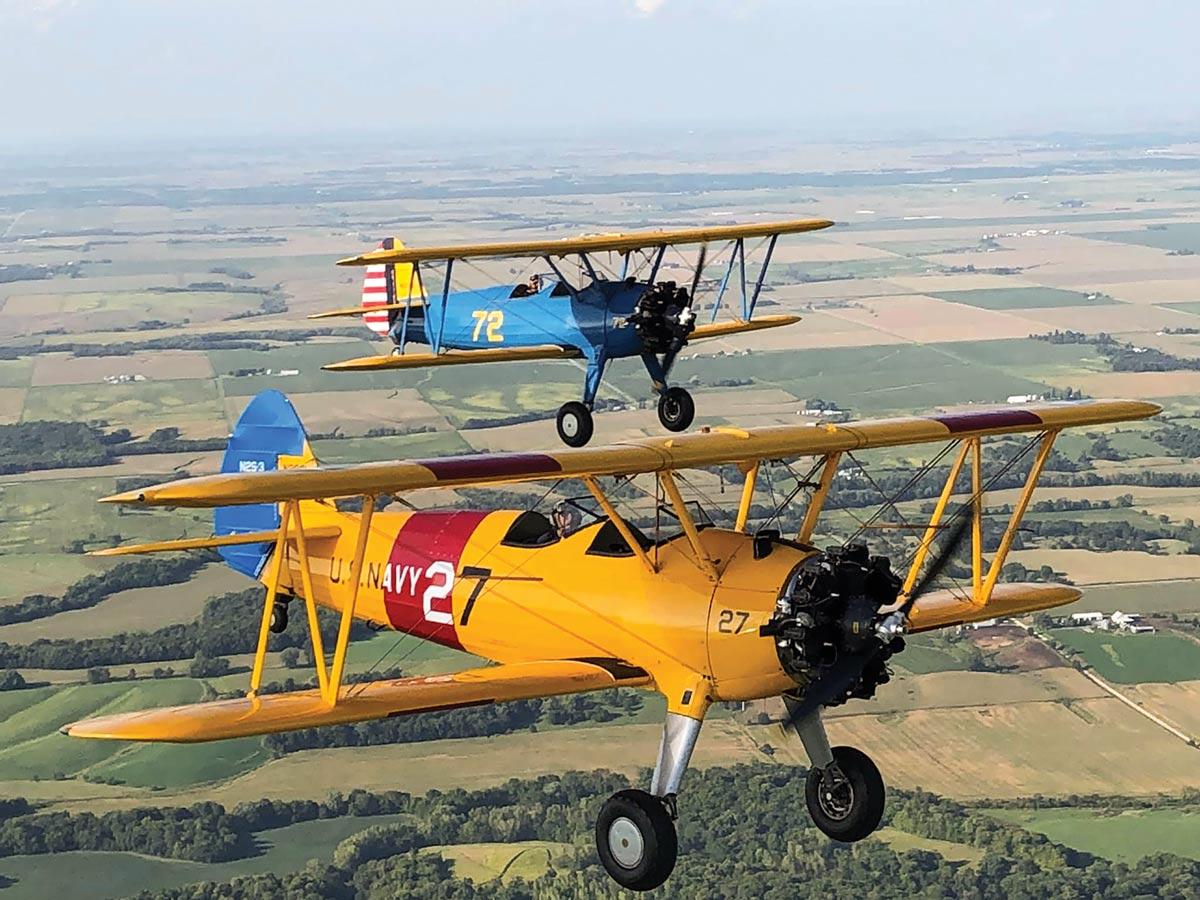
The planes were the first trainers for military pilots, allowing them to “cut their teeth” before progressing to more advanced trainers, fighter planes and bombers. In fact, many historians attribute the biplanes’ role in enabling American wartime aviation to take off.
“They were the primary trainer to the very end of World War II and then were phased out of service very quickly,” explains enthusiast Michael Rutledge, a former military pilot and current president of the Stearman Restoration Association. “The reason so many of them exist right now is that after the war, many Stearmans were bought up by agricultural aerial applicators, and the plane formed the backbone of the American crop-dusting industry for the next 20 or 30 years, because they were so available and so rugged.”
Rutledge, a Galesburg native who now lives in Casa Grande, Ariz., says Stearmans are easy-to-fly airplanes, with a few exceptions. “Landings, takeoffs and ground handling can be challenging, but that design flaw taught aviators from all the services. It was a characteristic that had benefits.”
Another characteristic is the way the plane is flown. Stearmans feature two cockpits, one right behind the other. “Both cockpits are equipped the same way,” Rutledge explains. “With a passenger, you can fly from either the front or back cockpit, but, because of the center of gravity and to equal out the weight and balance with the fuel tank in the center section of the top wing, if you are flying solo, you have to fly it from the rear cockpit.”
Flying one of the planes is enjoyable, says Dick Sisson, an American Airlines 737 pilot from Virden. “The open cockpit, the views, the sound of the engine and being one of the smoothest airplanes you’ll ever fly, makes it a fun,” he says. Sisson also owns a Piper J-3 Cub vintage aircraft. “It’s an incredible plane to fly, but if I have a choice, I almost always will pull the Stearman out.”
Rutledge agrees. “It just truly allows you to enjoy all of the sensory perceptions of flight,” he shares. “It’s slow, relatively speaking (a flying speed of about 80 knots or 100 miles per hour), so you get virtually unlimited visibility and the wind in your face.”
Fly-In board member and president of the National Stearman Foundation Philip Wolford of Abingdon remembers being introduced to Stearmans when a couple of pilots used the airstrip on his family’s farm, about 50 miles west of Peoria, as a base for aerobatic maneuver practice. He recalls being hooked on them immediately.
“It’s the colors, the noise, the smell, the look of them — it’s everything,” he says. “They’re just really, really neat airplanes.”
Thomas Hatley of Chesterfield has owned a Stearman for two decades. He calls it “a very honest airplane,” noting the challenges of landing a tailwheel aircraft. Simultaneously, he says flying the bi-wing plane gives “a sense of pure aviation.”
A primary care and emergency medicine physician and a consumer-member of M.J.M. Electric Cooperative, he was also a naval aviator. He says of all the planes he’s flown, from trainers to jets, the Stearman ranks near the top.
“They all have their characteristics, and they’re all fun in their own way, but I think — and I think some of my pilot friends would back me up on this — the Stearman is probably one of the most fun aircraft I’ve ever flown.”
The fun swells for Hatley, Wolford and other fans of the mid-century aircraft during the annual National Stearman Fly-In held each Labor Day weekend in Galesburg. “It’s probably the largest gathering of Stearmans you’ll ever see,” Hatley says. “You see all of the different variations, the different models and the different color schemes.”
Pilots from all over the nation converge on western Illinois for what many refer to as a “family reunion.” Organizers expect as many as 100 biplanes for this year’s gathering. The 50th anniversary Fly-In in 2021 brought more than 150 Stearmans, including one from the United Kingdom. The pilot shipped his plane to Florida, reassembled it and then flew to Galesburg.
“We get them from everywhere,” Wolford comments. “We even get some from California. It takes them a week to get here, they stay for a week, and then it takes them another week to get home, because it’s not a very fast airplane.”
The Fly-In is a weeklong gathering with events ranging from seminars and aerobatic contests to mass fly-outs to nearby communities for breakfast and even a Stearman flyover as part of Galesburg’s annual Labor Day parade.
“The Fly-In is a unique event in aviation, not just in vintage aviation or for Galesburg,” Rutledge says. “Once a year, the sleepy little airport is transformed into the largest gathering of Stearman airplanes in the world, all in one spot. It’s comforting and simply a gathering of family.”
Photos courtesy of National Stearman Fly-In