
As she brought the tip of her skate to the starting line, she assumed her position. The starting gun went off. She raced the first 100 meters and could hear the public address announcer state the split times. She knew she was hundredths of a second ahead — her biggest opponent was typically faster. She remembers thinking that if she could skate a regular lap, she should be able to beat her. As she crossed the finish line, the crowd knew before she did. As the saying goes, the rest is history.
Born for the ice
No one could have foreseen the 2-year-old, whose feet were so small she had to wear shoes inside her skates, going on to win Olympic gold. Bonnie Blair grew up in Champaign in a family of skaters, but unlike her siblings who chose to pursue college degrees, Bonnie chose to persist.
Bonnie can’t recall ever going on a family vacation; instead they traveled many weekends to skating competitions. Equipment and travel, both stateside and international, are expensive. Bonnie credits the community support she received as an impetus to push forward.
As a teen during summer, Bonnie played recreational softball. Her coach worked for the Champaign Police Department and inquired about her skating and the costs involved. After meeting with Bonnie and her father Charlie, the police department offered its support.
“The Champaign Police Department hosted different fundraising events around town. I think of it as my whole hometown being my sponsor, because they showed up to support me,” she explains.
Typically, around the first of October, Bonnie would travel to Germany because it would have the earliest ice. This was at a time when practice was outside. Even when she started winning and was able to fend for herself financially, the community still took interest in this kid that grew up in Champaign. They started hosting “watch parties” before they were popular.
“I want to think that my community spearheaded these things,” she says. “Back in 1988 and ’92, those things weren’t happening, but they were in Champaign.”
She qualified for her first Olympics in 1984. At the time, she was competing in both short- and long-track events, eventually switching over to the long-track 500-, 1,000- and 1,500-meter races.
At the 1988 Winter Olympic Games in Calgary, Canada, she was up against strong competitors on the Chinese and East German teams, including Olympian Christa Rothenburger. Choking up at the memory, she recalls her feelings when she crossed that finish line.
“I beat her by two one-hundredths of a second — that’s about 10.5 inches. We had the exact same lap time, but I beat her in the first hundred meters,” she recounts. She took the gold medal and set a new world record at the same time. She went on to earn a bronze medal in the 1,000-meter race.
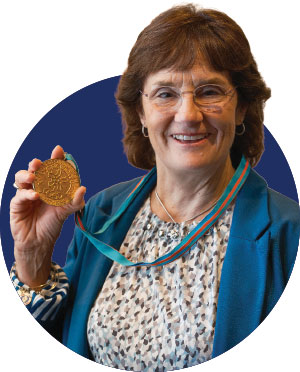 At the 1992 Winter Olympics in Albertville, France, Bonnie swept the gold medals in the 500- and 1,000-meter races. It was the first time a woman had successfully defended her title in the 500. At the Lillehammer, Norway, Olympics in 1994, she not only won the 500 but put up a 1.38-second margin of victory, the largest in Olympic history. She missed the bronze medal at 1,500-meters but set an American record — the fastest she had ever skated.
“Race per race, that was my best executed race at the Lillehammer games. I was just as excited for that race as I was for the other two because I set a personal best,” she explains. “I accomplished the goals I had set out for that race. Winning doesn’t always mean being first. Winning means you’re doing better than you’ve ever done before.”
U.S. Coach Peter Mueller, a 1976 Olympic gold medalist in the 1,000-meters, commented, “It’s like she was born on ice. Her long strides make her the best technician in the world, man or woman, over the sprint distances.”
A member of four Olympic Speed Skating teams, Bonnie won five Olympic gold medals and one bronze from 1988 to 1994 and holds numerous world records. To date, she is the most decorated American female Winter Olympian.
After her success in 1992, Bonnie continued to compete. She moved to Milwaukee, Wis., and began training at the Pettit National Ice Center, a newly opened, state-of-the-art indoor ice rink. She competed in the 1995 World Championships on her 31st birthday, March 18, 1995, won the 500, and shortly after, retired.
The following year, she married David Cruikshank, her former teammate and fellow speed skater. And, although she retired from the sport, she was never far from it.
The road to the Olympics
Other than talent, in order to become an Olympic-caliber athlete, Bonnie says it also takes drive, passion, a willingness to listen and be coached, and people who will be there to support you and help you chase what you want to do.
She compares it to a tire on a bike. “They all have spokes, and they all have to be tightened in a good way to make it roll in a perfect circle,” she explains. “Having a core group around you is what creates that balance and makes success possible.”
It takes a desire to work every day, even when you aren’t having a great day. It’s about digging down deep inside to get it done.
“For instance, my husband was in four Olympics. Between the two of us, we have five gold and a bronze, and yes, they’re all mine,” says Bonnie. “But guess what? He knows he put in the blood, sweat and tears to be the best he could be. He can hold his head high knowing he tried, executed and learned so many things in life. It’s about perspective.”
DASH
Bonnie and Dave are passionate about advancing the sport of speed skating.
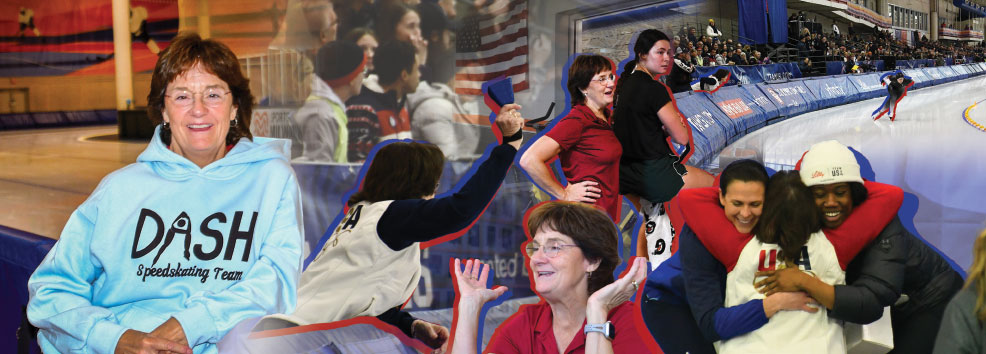
Bonnie is currently the director of community engagement for The DASH Project, Inc., a 501c(3) organization with a mission to grow speed skating. DASH stands for Developing Athletes for Speedskating High-Performance. Dave is president and head coach of the organization.
The organization’s Gold Medal Advisory Board is a who’s who of gold medal speed skating excellence: Bonnie Blair-Cruikshank ’88, ’92, ’94; Dan Jansen ’94, Joey Cheek ’06, Chris Witty ’02, Chad Hedrick ’06, and Casey FitzRandolph ’02.
“Dave and I dream of getting more athletes into the sport,” says Bonnie. “It isn’t a typical sport like football or basketball, nor is it collegiate based. It takes a lot of commitment from parents and athletes alike.
“Dave’s mother would drive him from the Chicago suburbs to Milwaukee every single day while he did his homework in the car. That’s the story of so many speed skaters. It’s hard to find parents and kids who are willing to commit that time, but we’re always trying and are up to the task.”
The couple is always looking at public ice-skating sessions for kids who look like they could have that desire. The number of individuals chasing the medal podium is dwindling, and the DASH program offers ways for them to try out the ice. They work with some hockey groups where kids come try speed skating on evenings when they aren’t practicing.
Specialized skates are available to those who want to try speed skating, and races are set for them to get on the ice and try it. The students don’t have to buy into U.S. speed skating unless they get to the point where they want to move up. The group wants to be proactive. The sport isn’t cheap, but by eliminating a possible deterrent, it allows kids the opportunity to try. If their feet grow, they can get a larger size skate.
Skaters vary in age from those just learning to skate and race to a junior group that has made a bigger commitment to the sport. Dave works with the more advanced group.
Practice involves more than time on the ice, it’s about physical literacy and learning to move their bodies.
“It’s more encompassing than just giving them the experience of the sport Dave and I thoroughly loved, grew up in and are still embedded in. We hope we’re getting kids moving, teaching them life lessons and giving them the experience of a good, wholesome, healthful sport,” says Bonnie. “We want to touch kids’ lives and put a smile on their faces. When you see them racing and how excited they get, that’s priceless.”
Who to watch in 2026
The 2026 Winter Olympics will be held in Milan-Cortina in northern Italy Feb. 6-22, and the U.S. has several athletes who could be medal contenders. The 2026 U.S. Olympic Speedskating Trials were held Jan. 2-5 in Milwaukee. Visit usspeedskating.org for a full team listing.
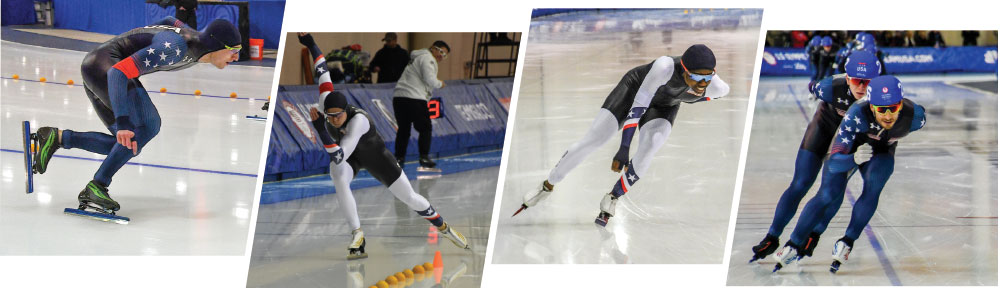
Keep an eye on Jordan Stolz, the youngest world champion in the sport’s history and the reigning World Cup champion. Watch for him in the 500-, 1,000- and 1,500-meter and mass start races.
Brittany Bowe is a two-time Olympic bronze medalist and will compete in the 1,500-meter and team pursuit races. Erin Jackson is the reigning 500-meter champion and the first Black woman to win an individual gold medal in Olympic history. She should be a gold contender in the 500. Casey Dawson set his third national record in 5,000-meters on the way to his first World Cup in Calgary.
The U.S. men’s team pursuit consisting of Dawson, Emery Lehman and Ethan Cepuran set a new world record at the Salt Lake City World Cup race. Both Lehman and Cepuran are Illinoisans, from Oak Park and Glen Ellyn, respectively. In addition to Lehman and Cepuran, Sarah Warren made her first Olympic team. She is from Chicago and will compete in the 500-meter race.
While not vying for a medal in 2026, Bonnie and Dave’s daughter, Blair, is currently “sitting around sixth or seventh in the 500 and is working on her turns,” explains Bonnie. “If her desire and everything is still there, she’s looking at 2034 when the Olympics are in Salt Lake City, Utah.”