
The Buchanan Center for the Arts in Monmouth opens doors to the appreciation and experience of art to the members of its rural community and those surrounding. From outreach to local schools and public service organizations to collaboration with the nearby college and local library, its impact can be felt throughout Warren, Mercer and Henderson counties. That impact is fueled by the efforts of community members past and present filling a myriad of roles.

The center, founded in 1989, is the legacy of former resident Grace Buchanan, described as “a country girl at heart who developed a passion for the arts.” Her belief that all people should have access to the performing and visual arts ultimately led to the provision of those opportunities in the area through her estate. Members of the center and donors continue to further her mission monetarily.
Its home base, a building that housed the first public library in the state of Illinois, hosts changing exhibits in its Pattee and James Keefe galleries. A dedicated gallery space in the classroom features works by Harlow Blum,
a former art professor at Monmouth College, and an exterior wall boasts a mural celebrating the arts created by a former artist in residence.
One of the center’s major outreach efforts is its Art Presenter Program, originally created by Blum’s wife Lila and a group of fellow teachers to promote the arts to children in grades K-5. “Schools are in dire need of arts education, considering the cuts that are happening,” says Rebecca Quick, Buchanan’s program coordinator and social media curator.
Buchanan board member Sarah Mayfield manages the program, which includes scheduling its 60-plus volunteers. “She gathers all the volunteers for the schools in the area,” Quick explains. “It is sectioned off into each grade level, so kindergarten [for example] will have different pieces [of artwork], and those will rotate through the schools each month.”
Quick teaches in the center’s newly renovated classroom space. “I teach classes to anyone from [ages] 5 to 105,” she laughs. “I try to make classes that are specific for kids as well as adults. I [also] teach a summer art series [and] implement things [kids] might not do [in school], like plaster craft and paper mache.” The recent renovation included a new kiln for the classroom, which has further expanded class options.
Quick became involved with the center as a former artist in residence herself, which eventually led to her current role. “Being an avid artist and fan of the arts, I believe [art is] an integral part of education, giving kids the chance to be creative and diversify their knowledge,” she says.

Classes take place outside the facility as well, whether it be home school Fridays at Warren County Public Library or during visits to the Warren Achievement Center, an educational facility for the mentally and physically disabled. The center also coordinates with Monmouth College. “We do a lot of collaboration,” says Quick. “I do different fairs and events they have on campus to promote the center.”
Buchanan Center for the Arts also has authority as a regranting agency for the Illinois Arts Council Agency (IACA). This designation allows the center to grant IACA funds, along with matching funds raised locally, to arts groups, organizations, schools and artists in Warren County. Recent grant recipients include the Immaculate Conception School, Monmouth College and the local dance studio, among others.
Operated by a staff of only three — a soon-to-be full-time executive director, a creative assistant and Quick — volunteers are a much-needed resource. Quick says that she sees more than 100 people contribute their time during any given season. “Throughout the year, we have people coming in to help us hang and tear down shows,” she explains. “I see 25 kids in each of [our art] sessions, and I see two sessions a day, so it’s a lot of hands on deck to make sure everything is cleaned up and ready for the next class.”
There are six shows each year — the first, which takes place January-February, originates with a call to artists. “That one is a changing exhibition,” says Quick. “March and April is our Town & Country Art Show, which features artwork from local schools. It’s open to any child wanting to submit their work. I believe last year we had just under 400 pieces in [that] show.”
May and June is another call to artists, followed by Art from the Heartland in July and August, which features work from regional artists. The 64 Arts National Juried Exhibition — which brings works by artists from across the nation — runs September-October, and the Security Savings Bank Amateur Photography Show finishes out their calendar year.

Of the six, two of the exhibitions are juried — 64 Arts, named in honor of the 64 spaces on the Monmouth public square, and Art from the Heartland. “64 Arts [is a] national juried show, probably our most prestigious show of the year. This year, we have 43 artists from 13 different states,” she says. Community members often serve as jurors for the shows. “Generally, it’s either an artist or an arts teacher in the area,” adds Quick, who also served as a juror prior to working at the center.
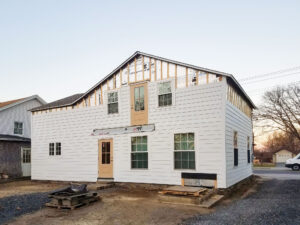
Despite the many facets to the center’s current programming, more are planned, including renovations to the building’s currently unused second floor. “We’re just finishing a capital campaign and beginning construction,” says Ann Tenold Rogan, the center’s newly appointed executive director. She says plans include installing an elevator. “The second floor right now is not a usable space, [but] it’s a beautiful space. … When it opens, it’s going to double the space we have available. … Upstairs will be a whole new venue.”
Rogan says they would like to host plays and other performing art pieces in the new space, perhaps even square dance lessons. “We’re talking about partnering with local mental health groups to do some art therapy classes upstairs,” she adds.
Rogan grew up in Monmouth and recently returned. “My mother was a potter. My dad, when he retired from the bench, started a woodcarving career,” she says. “Both of my parents were pretty artistic.” When it became clear art wasn’t where her own talents lay, she went into nonprofit management.
“I want us to get a donor database and work on our community connections and partnerships and things like that,” Rogan explains. “[Our] board of directors has a membership of 15 and is incredibly involved — there are eight different committees. They meet almost every month, and they are very hands-on.”
She believes their level of involvement helps the center be seen as a true community partner. “Board members and staff will go and talk about different programs and partnerships we have [on local radio],” says Rogan. “We just joined the Monmouth Greater Chamber of Commerce. I met with the executive director there, and we’re talking about what Buchanan can do for Christmas on the square.”

Another outreach effort in the works involves the oral tradition of storytelling. “Back in the ’80s, an arts council did a writing project with the senior citizens of each county,” explains Rogan, adding that Warren County residents participated in that undertaking. “What we would like to do is pull those archives, create a companion writing piece for today’s senior citizens, [and] do some programming on how those stories compare. We got that idea from the Twin Rivers Arts Council, [which] spearheaded the original writing program.”
The breadth of their projects epitomizes the broad definition of the word “art,” she says. “It’s not just fine arts hanging on a wall to be viewed. It’s also your own personal experiences with it, creating memories with the people you are with while you [have] those experiences,” Rogan continues. “We were also talking about having intergenerational art programming. … You could do that with all sorts of different types of relationships. … That’s what we’re thinking for the second floor.”
She remembers her mother having exhibits at the center and is almost sure her father was on the board of directors at some point. “It’s a nonprofit that has deep roots for as old as it is,” she says. “If the vision isn’t carried on or adopted by the community, it [only] lasts a generation. [The center’s longevity] is a testament to the stability of the organization … and how important it is to a rural community like this.”
Robust membership also contributes to its longevity, and free programming for members and children bolsters its impact. “There are probably 100 people who come to each art opening, and hundreds will see a show between when it goes up and when it comes down,” she adds, noting that she expects those numbers to increase with the more interactive experiences planned for the additional space upstairs. “I think you’re going to really see it popping.”

While not an artist herself, Rogan loves the stories that different works of art reveal about the time of their creation. “The further away you get from it, the more you can tell about it,” she explains. “Different interpretations of a single piece will change over history, because you’re looking at it through the filter of your life. … Something may mean one thing in 1600 and may mean something else completely in 1800. It might have been loved in 1900 and hated in the year 2000. I just [find it] fascinating how complex … and subjective it really is.”
From its founder to its board and staff members, donors, volunteers, members, artists, professors, students, teachers, jurors and visitors — Buchanan Center for the Arts also tells a story — the story of a rural community coming together to offer the arts to all.
“Everyone has a spot at the table for art,” says Quick.