
Long before becoming the 21st state, and just two years after the Continental Congress officially adopted the Declaration of Independence, the area that would later become Illinois played a pivotal role in the Revolutionary War.
As the U.S. celebrates its 250th anniversary — or semiquincentennial — it’s time to look back on the role Illinois played in the fight for freedom.
While Kaskaskia has a population of only 21 according to the 2020 U.S. Census, the community is rich with history. For one, it holds the title of Illinois’ first state capital, albeit only for a short time — from 1818 to 1819 — before moving to Vandalia. However, it was also the capital of the Illinois Territory from 1809 to Illinois’ statehood on Dec. 3, 1818.
Two, it is the only inhabited portion of Illinois located west of the Mississippi River — visitors must enter through Missouri as most of the original town was swallowed by the Mighty Mississippi and cut off from the rest of Illinois.
But most significantly, on July 4, 1778, Kaskaskia was the location of a victory that helped change the course of the Revolutionary War.
The village of Kaskaskia, which today is powered by Egyptian Electric Cooperative Association, was originally formed in 1703 by French Jesuit missionaries. It was named after the Kaskaskia, a historical Indigenous tribe in the Illiniwek Confederation who inhabited the area.
The settlement later grew to be the center of French life in the Illinois Country and became a thriving community, thanks to fertile soils for agriculture and Mississippi River trade routes for fur traders.
In 1765, the area was occupied by the British. Two years to the day after the U.S. declared independence from Great Britain, George Rogers Clark and his band of militiamen overtook the British-controlled village without firing a shot.
Many historians consider Clark’s Illinois campaign as one of the most consequential but least-known of the Revolutionary War. The victory was strategically important, because it gave the Americans control of a vast region stretching across the western frontier, weakened British influence and strengthened American claims to the Northwest Territory during postwar negotiations.
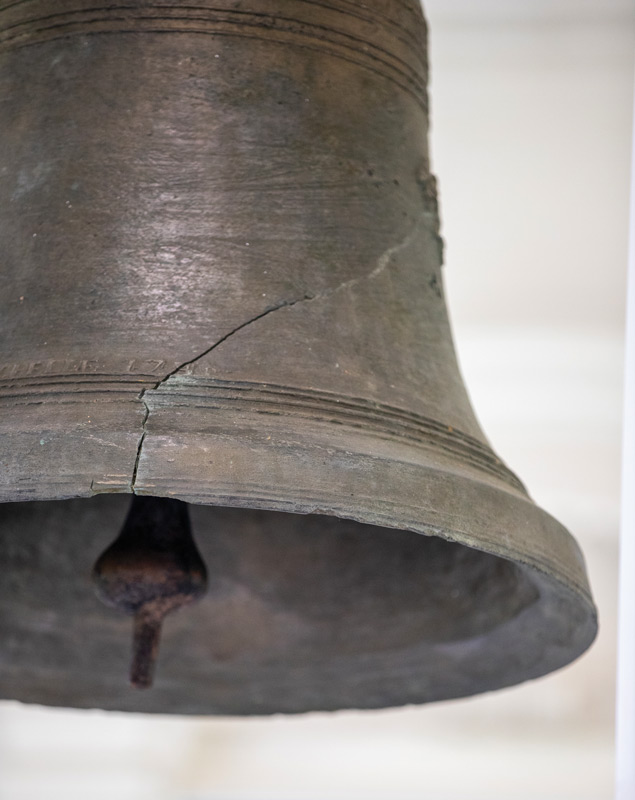
According to the National Endowment for the Humanities, the bell at Kaskaskia’s Church of the Immaculate Conception, founded in 1675, rang in celebration following the capture. That bell later came to be known as the Liberty Bell of the West and a rare surviving artifact west of the Appalachians directly related to the Revolutionary War. Over time, it developed a crack and, as a result, can no longer be rung.
The bell, which was cast in La Rochelle, France, in 1741 and given to the Catholic Church of Illinois by France’s King Louis XV, remains on display today near Immaculate Conception Chapel along 1st Street on Kaskaskia Island.
The Kaskaskia Bell State Memorial is a small brick building open daily, sunrise to sunset. Tours are self-guided. While visitors cannot step into the building, the bell can be viewed from a gated entrance. With a press of a button, the door opens and a 1-minute audio recording can be heard.
On July 4, an annual Independence Day program held there celebrates the victory.
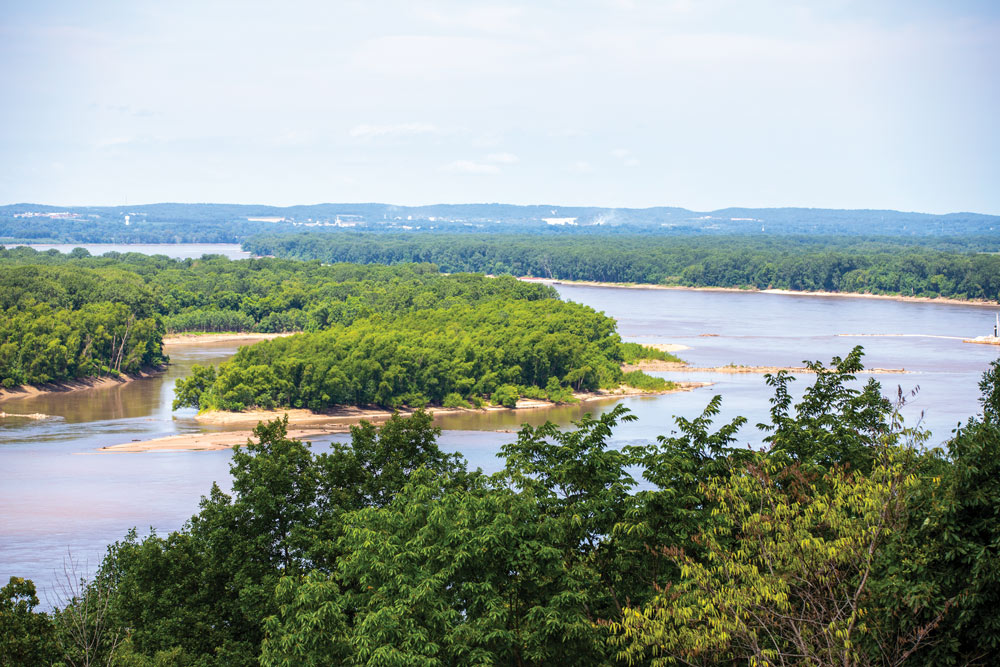
The current Kaskaskia is located about 3 miles away from the original settlement. Though the Mississippi River had once helped make Kaskaskia prosperous, it eventually became the town’s undoing. Much of the settlement was swept away by the Mississippi River during a flood in April 1881.
The flood caused the Mississippi to dramatically change course. Instead of flowing west of Kaskaskia, the river shifted eastward into the channel of the Kaskaskia River. That shift placed the Mississippi directly in the path of the town. By 1909, the old village of Kaskaskia had all but disappeared.
Thankfully, not all of old Kaskaskia is gone. Perched high above the Mississippi River, on the eastern side, sits the Fort Kaskaskia State Historic Site, which consists of the remains of Fort Kaskaskia, Garrison Hill Cemetery and, ironically, a Mississippi River overlook, which provides a view of the river and Kaskaskia Island.
The earthen remains of Fort Kaskaskia are still visible. Raised embankments form a rough square with defensive bastions at each corner. According to the Historic Preservation Division of the Illinois Department of Natural Resources, the small French fort was built around 1759 to help protect the nearby village.
Modest in size, Fort Kaskaskia played a role in the region’s frontier history. Historical accounts indicate the fort contained only a three-room barracks and a kitchen, and it may never have been fully completed. French and U.S. troops occupied the site periodically until 1807, and residents reportedly sought refuge there during periods of unrest associated with the War of 1812.
Adjacent to the fort’s remains is Garrison Hill Cemetery, established by the Illinois General Assembly in 1891 to protect the graves of early Kaskaskia settlers whose burial sites were threatened by the Mississippi River. A prominent monument erected in 1892 honors those pioneers and serves as a reminder of the once-thriving community that stood below.
Archaeologists continue to study the original town site, hoping to uncover new details about one of Illinois’ earliest settlements.
Also located within the boundaries of Fort Kaskaskia State Historic Site is the Pierre Menard Home. Menard was Illinois’ first lieutenant governor from 1818 to 1822, and his 1815 home is a well-preserved example of French Creole-style architecture. The grounds are open daily, sunrise to sunset, and tours are available Wednesdays through Sundays mid-May through mid-November.
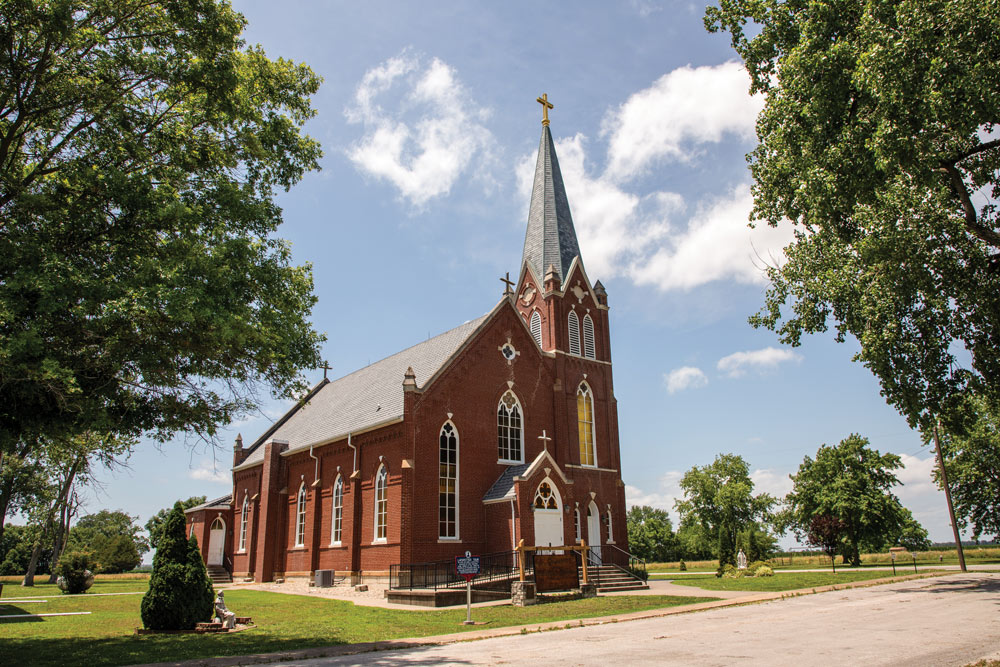
Today, visitors are free to roam the historic area to celebrate Kaskaskia on both sides of the Mississippi River. On Kaskaskia Island, they will find a peaceful landscape of farmland and a quiet community. And, although only a small population remains today, Kaskaskia’s influence far exceeds its size.
When the Treaty of Paris ended the Revolutionary War in 1783, American negotiators secured the Northwest Territory. That land would eventually become Illinois, Indiana, Michigan, Ohio, Wisconsin and part of Minnesota. In that sense, the events at Kaskaskia helped determine not just Illinois’ future, but also the map of the United States as seen today.
In that respect, even though the Liberty Bell of the West no longer rings, it still acts as a symbol of independence and freedom that reverberates 250 years later.
25 consequential Illinois moments in American history
1778 – Capture of Kaskaskia – Helps secure the Old Northwest for the U.S. during the Revolution.
1784 – Illinois ceded by Virginia to the U.S. – Helps create the Northwest Territory and establish the framework for westward expansion.
1803-04 – Lewis and Clark winter at Camp Dubois – Launch point for the nation’s most famous exploration expedition.
1809 – Illinois Territory created – Congress separates Illinois from the Indiana Territory, paving the way for statehood.
1818 – Illinois becomes 21st state – The Union expands and strengthens the free-state presence in the Midwest.
1836 – Illinois and Michigan Canal construction begins – Linking the Great Lakes and Mississippi River systems helps make Chicago the nation’s transportation and commercial hub.
1837 – Chicago incorporated as a city – Begins the rise of America’s premier inland city and rail center.
1846 – Mormon exodus from Nauvoo – Influences western settlement and the development of Utah.
1858 – Lincoln-Douglas debates – Elevates Abraham Lincoln to national prominence and frames the slavery debate.
1860 – Abraham Lincoln elected president – Directly shapes the Civil War and preservation of the Union.
1871 – Great Chicago Fire – Transforms urban planning, fire codes and skyscraper development nationwide.
1886 – Haymarket Affair – Influences labor rights and inspires International Workers’ Day worldwide.
1893 – World’s Columbian Exposition – Introduces millions to new technologies and shapes American architecture and city planning.
1908 – Springfield Race Riot – An outbreak of racial violence becomes a catalyst for the founding of the NAACP the following year.
1917 – East St. Louis Race Riots – One of the deadliest racial massacres in U.S. history, it exposes the nation’s racial tensions and helps galvanize early civil rights activism.
1926 – U.S. Route 66 BEGINS in Chicago – The “Mother Road” connects the Midwest to the Pacific Coast, transforming American travel, tourism and pop culture.
1933-34 – Century of Progress World’s Fair – Held in Chicago, it showcases innovation during the Great Depression.
1942 – First controlled nuclear chain reaction achieved – At the University of Chicago, scientists working on the Manhattan Project usher in the atomic age and transform warfare, energy production and scientific research.
1955 – O’Hare opens to commercial passenger service – Chicago’s international airport begins its rise to one of the world’s busiest aviation hubs, helping shape modern air travel.
1960 – First televised presidential debate – Held in Chicago, the Kennedy-Nixon debate transforms American political campaigns by demonstrating the power of television.
1973 – Completion of Sears Tower – Now known as the Willis Tower, the former tallest building in the world symbolizes advances in skyscraper engineering worldwide.
1985 – First Farm Aid concert – The Champaign event draws national attention to the farm crisis and rural America.
1993 – Development of the Mosaic web browser – The University of Illinois becomes home to the first widely popular graphical web browser, which helps transform the internet from a research tool into mainstream technology.
2008 – Barack Obama Wins Presidential Election – Illinois’ U.S. senator makes history as nation’s first Black president.
2021 – SAFE-T Act passes – Illinois is the first state to eliminate cash bail and becomes a national focal point in debates over criminal justice reform, pretrial detention and public safety.