Illinois Centre Mall in Marion lost its luster years ago. Like many other malls throughout the nation, it fell victim to changes in consumer behavior, including the rise of online shopping. The once bustling Williamson County retail mecca shed specialty shops, its food court and all but two anchor stores.
Now, it is being brought back to life and more, thanks to a public-private deal made possible by a pioneering state law geared at juicing economic development.
One side of the mall has been transformed into ThrillHouse Family Entertainment Center, a 100,000-square-foot recreation center that offers such activities as go-kart racing, bowling, laser tag, axe throwing and high-tech miniature golf. A full-service restaurant offering meals and drinks is prominent. On the grounds north of the mall, other recreational venues are being constructed.
Much of the new development is the result of Illinois’ first Star Bond, an innovative economic tool aimed at drawing visitors from other states, along with their money. The law allows the issuance of bonds by private investors, in this case Rodney Cabaness and Shad Zimbro, partners in other ventures that are separate from the Star Bond project.
Projects include motorcycle and RV dealerships, a golf course, a baseball stadium, a golf driving range game similar to Top Golf, and an amateur sports venue with multiple baseball, softball and pickleball fields, including a domed stadium.
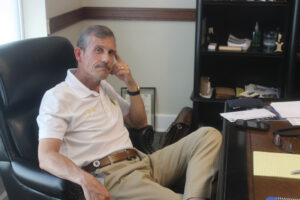
“In a nutshell, the (Star Bonds) legislation allows for a municipality to choose a private developer and make a partnership with them, so long as it meets certain statutory requirements,” says Marion Mayor Mike Absher. “A percentage of customers have to come from certain miles away. The idea is to get people from out of state, from Kentucky, southeast Missouri and southwest Indiana.”
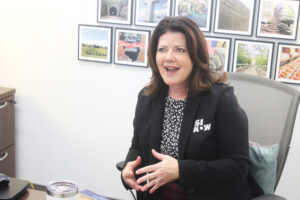
The project dovetails with efforts by a new economic development organization to draw industry to the region. Southern Illinois Now — often referred to as SI Now — was formed a few years ago by business leaders, political figures and other stakeholders who tout the region’s scenery, recreation areas, transportation system and educational opportunities. It encompasses 17 of the southernmost counties in Illinois.
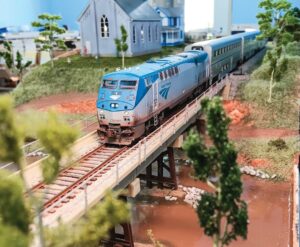
Deb Barnett, SI Now’s chief executive officer, points to the “Four Rs”: rivers, roads, rails and runways. Two major rivers — the Mississippi and Ohio — frame the southern point of Illinois. In addition, there are five Class 1 rail lines, Amtrak stations, a network of interstate highways and commercial air service to Chicago via Marion’s Veterans Airport of Southern Illinois.
“That central location and those transportation and logistics assets have really put southern Illinois on the radar when companies look to get closer to customers,” Barnett says. “We’re five hours from major markets and a two-day trucking distance of 80 percent of the U.S. population.”
While market access is a big draw for business, cost of living may be even bigger.
“Lower cost of living is definitely a key asset that we have,” Barnett says. “Those of us who have lived here all our lives know that buying a home here is very affordable. And there is the hometown and neighborly feel. Plus, you can get to many major cities quickly.”
According to real estate companies like Redfin and Zillow, the average home price in the region is about half that of the state average.
SI Now is not the first economic development group in southern Illinois, but Barnett believes this one has widespread support across the region.
“There have been several regional initiatives over the years,” she says. “But in 2017, a group of business leaders came together and realized the need for growth. They have their own economic development staff, but for the most part, the region as a whole was being left out when looking to expand in the area. We were not on their radar.”
Barnett and others cite the abundance of recreational activities as a lure for economic development. The Shawnee National Forest — Illinois’ only national forest — is an outdoorsman’s paradise. The nearly half-million-acre forest stretching across the southern tip of Illinois offers hunting, fishing, hiking, horseback riding, rock climbing and other activities.
Just north of the Shawnee, spanning parts of Franklin and Jefferson counties, lies Rend Lake. At 18,000 acres, it is the state’s second largest reservoir. Not only does the lake offer multiple recreational opportunities, it supplies water to more than 30 communities.
Absher got the initial idea for the transformation of Illinois Centre Mall after a family visit to Gatlinburg in the Smoky Mountains. He believes southern Illinois can also be a major draw.
“We have this great natural resource,” he said. “Any one of these towns could be the Gatlinburg of the Shawnee [National Forest]. I think it’s one of the biggest opportunities out there.”
Illinois Rep. Patrick Windhorst, R-Metropolis, agrees. “Just the natural beauty of southern Illinois is a tremendous positive for our region,” he says. “The Shawnee National Forest is a great draw for tourism and for people to live here. They can enjoy a laid-back lifestyle with beautiful scenery.”
SI Now’s main focus is on attracting industry to the region. That involves marketing the region and educating the workforce. The group hosts task forces that include 100 stakeholders covering 17 counties, from Massac on the southern tip to Jefferson on the northern edge.
“We make sure all counties are well represented, from our largest communities to our smallest communities,” Barnett says. “We also want to focus on internal promotion, to ensure that those in southern Illinois appreciate what we have, telling stories of our region.”
The organization utilizes multiple media outlets to get out the message, including social media and an in-house magazine.
In Marion, the novel Star Bond project is the funding source of the nearly $250 million entertainment complex in and around the mall, on the west side of the city. Unlike municipal bonds, Star Bonds allow the creation of private-public partnerships with most of the risk being held by the private partner, in this case Cabaness and Zimbro.
“We’re collateralizing future sales tax that comes out of it,” Absher says. “They’re not general obligation bonds. Bond buyers understand up front that this is prospective; it’s riskier than loaning us money to buy a firetruck. There is a higher interest rate because it’s riskier.”
Indeed, those investors purchasing bonds can expect returns of 6% to 6.75% — about twice the return of a standard municipal bond. The developers are on the hook for any losses, though the city also has a financial stake because of temporary abeyance of sales taxes.
The future of the mall — where external surroundings are highly developed with retail establishments, hotels and restaurants — was long a hot topic for politicians. In his run for mayor in 2018, Absher made its future one of his top priorities.
“The city didn’t own it, so it was not necessarily our responsibility,” he says. “But we had invested probably $20 million over the years in infrastructure — roads, sewer lines, etc. So, we had a vested interest to see that it did not become an economic black hole. It was in bankruptcy at the time, and the parking lot was owned by another entity. It was a real hornets’ nest.”
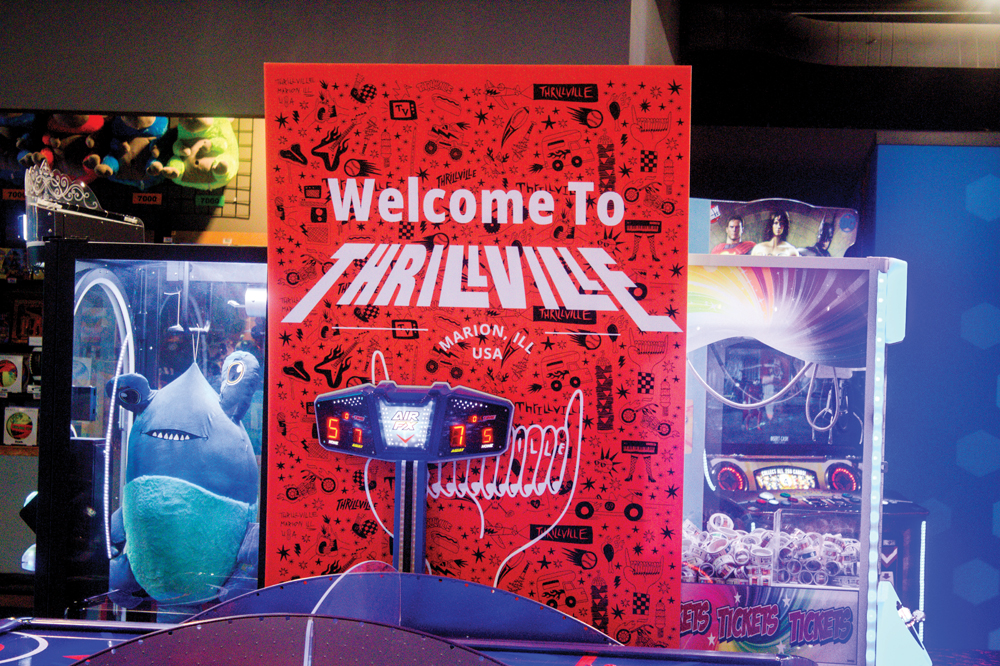
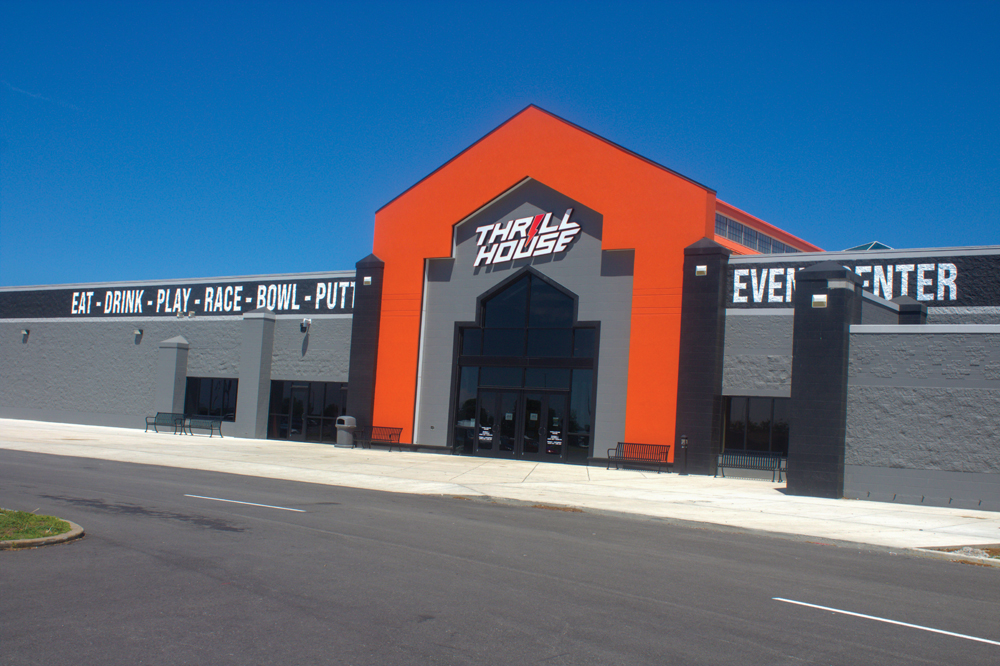

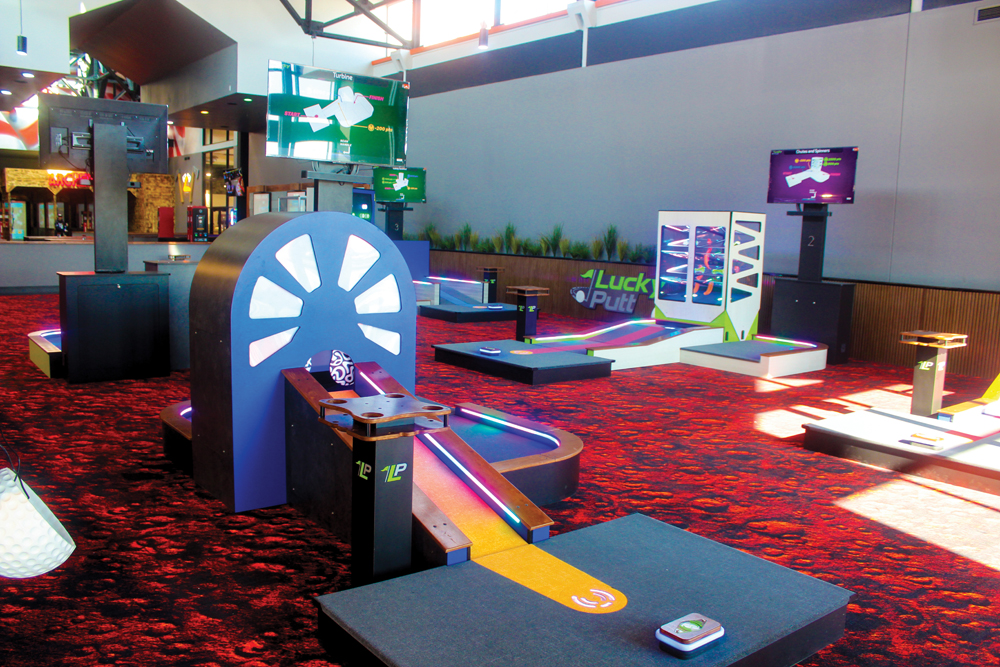
So far, the project is going well. ThrillHouse opened in April and has generated widespread interest. Developers hope that the other activities around it will draw people from all over. The Thrillville Thrillbillies play in the collegiate Prospect League. Home games are played at Mtn. Dew Stadium, with a capacity of more than 5,000. It is the centerpiece of a large youth sports development that will draw 50 to 100 traveling teams each weekend. In addition, the complex is expected to host collegiate baseball and softball tournaments.
“Whenever they’re playing, we’re incentivizing them to come here to the ThrillHouse and play,” says Bryce Cabaness, who is involved in the development. “It includes everything from coach-pitch to 18-year-olds in summer travel ball.”
Such ancillary projects fit right in with SI Now’s goals of providing tools to empower the private sector. It is funded solely through contributions by businesses. Southern Illinois Healthcare provides in-kind support, offering space in University Mall in Carbondale. Like Illinois Centre in Marion, University Mall has also lost many of its tenants. The nonprofit healthcare company purchased a large section to house its offices.
“We have 15 partners, and new ones are coming on all the time,” Barnett says.
SI Now promotes the region as what it is — a rural area that can draw workers from long distances. Employees at two of southern Illinois’ largest employers — Continental Tire in Mt. Vernon and Aisin Manufacturing in Marion — travel as far as 60 or more miles. Barnett makes sure prospective employers recognize the mobile nature of the workforce.
“That’s what we’ve had to do in educating site selectors,” she says. “They’re looking for a certain population. We have to educate them that we’re a commuter region. People will drive 45 minutes or an hour for a good-paying job. We have to tell that story. In southern Illinois, we’re heads-down, humble people with a strong work ethic. We always have them talk to our employers so they can hear about their experience with the workforce.”
One hurdle may be the state of Illinois itself. Windhorst says the government sometimes gets in the way of progress. “The biggest thing I see is that the state needs to be more business-friendly,” he adds. “One of my responsibilities of being an elected representative is to try to overcome that with collaboration within the region. We are promoting the possibilities, not dwelling on the negatives.”
Indeed, a newfound unity of cooperation is a common thread. In the past, the region struggled with Balkanization. That is changing, according to Absher.
“I can say very confidently, for the first time in my lifetime, there is an absence of outright animosity toward somebody else,” he says. “I’ve grown up here and know about some of the snarkiness. We’ve all made great strides to establish relationships with neighboring towns. It’s not uncommon for me to call the mayor of Herrin or Carbondale, or for them to contact me about opportunities opening up.”
Barnett agrees. “We thought competition would be a problem, and it has not been,” she says. “I was a little surprised by that, to be honest. Historically, as in any area, there is this competition between communities. We promote heavily that a win for one is a win for all.”